
The Summer I Turned Pretty
Part I: Prelude, Love Triangle


We tend to talk informally about other people’s marriages and to disparage our own talk as gossip. But gossip may be the beginning of moral inquiry, the low end of the platonic ladder which leads to self-understanding. We are desperate for information about how other people live because we want to know how to live ourselves, yet we are taught to see this desire as an illegitimate form of prying.
—Phyllis Rose, Parallel Lives: Five Victorian Marriages1
When we talk about the lives of others, we are always, in some sense, talking about ourselves. After all, it is largely through the stories of others that we negotiate the parameters of acceptable and unacceptable behavior, decide with whom we wish to associate and whom we wish to avoid, scrutinize the points at which the norms that govern our lives are put under pressure or outright overturned. Gossip thus takes on a kind of instructive function: from it, we can learn something of how we ought to behave. More insidiously, gossip may also serve to mediate hidden desires or fantasies, things we scarcely admit to ourselves. It provides an imaginative space where we can speculate, even if unconsciously, what might happen if we cheated, if we transgressed taboo. Our vicarious interest always involves a latent identification, whether we realize it or not.
Most of us rarely express such concerns, explicitly, in the context of our own lives. Gossip provides a necessary level of distance—the distance of having happened to other people—that allows us to explore these questions without the immediate anxiety sustained self-reflection always entails. At the same time, that distance permits the disavowal of our personal involvement in the narratives we reproduce. Gossip can be conveniently dismissed as idle talk, unworthy of serious consideration, even though we are seldom being so serious as when we gossip. Were we to take gossip seriously, as (per Rose) “the beginning of moral inquiry,” its implications for our lives might prove more considerable than many of us are ready to contemplate.
Melodrama could be said to function in a similar manner. The hyperbolic surface of melodrama, its propensity for exaggeration and artifice, has an immediate distancing effect. Emotion is always very close to the surface in melodrama, much closer than it is in our day-to-day lives. Characters speak and act in ways we never would; they find themselves in impossible situations, as if fate itself were moving in tune to their agonies and ecstasies. Accordingly, emotion is expressionistically displaced onto décor and lighting. The mise-en-scène is saturated with the desire of the bodies that navigate it. No-one would mistake this artificial world for reality. But great melodrama nevertheless speaks of life’s very essences: our deepest yearnings, our most terrible fears, unspeakable guilt and impossible hope. The artifice is a beautiful layer, like the iridescent wall of glass at an aquarium, behind which we can view our suppressed passions. The direct expression of those passions would not be possible without this layer. Melodramatic artifice facilitates the open exploration of taboo; it alienates us to draw us close. A false world suffused with real feeling.
At its most precise, this approach can have a profoundly illuminating effect. It can even attain a “critical” register, as in the best films of Douglas Sirk, for instance. Unfortunately, since emotional excess is associated with women, and moreover since melodrama is generally pitched to women, the genre has had to fight hard for critical recognition. Even the critics who sought to rescue Sirk’s films from dismissal in the 1970s frequently resorted to perverse moves when justifying their admiration. As Tag Gallagher puts it: “Yes, they conceded, Sirk’s films were tacky melodrama, but as metaphor for smugness and decay. Actually, they argued, Sirk’s films were subverting the middle-class values they seemed to be endorsing. Actually, they insisted, Sirk’s films meant the opposite of what they seemed.” In order to recover Sirk’s films as art, the melodramatic surface had to be played off as a deception, a glossy package within which critical content could be smuggled right under the unsuspecting viewers’ noses. This interpretation presumes to rescue Sirk while degrading not only the generic form of his films, but the audiences that were moved by them; it admits his greatness only at the expense of melodrama as a whole. Audiences themselves have been complicit in this disavowal: behold the haste with which so many viewers diminish their own emotional responses to a “weepie” or “tearjerker,” or pre-emptively cut themselves off through mocking laughter (an inevitability at any contemporary screening of Sirk). Just as gossip, another classically “feminine” activity, is disparaged by its practitioners as vulgar chatter despite its serious ethical content, the “ironic” reclamation of Sirk too frequently preserves the misogynist disavowal of melodrama that the reclamation initially aimed to overcome. This form of argument, which, if my own experience is any barometer, persists in the academy to this day, is a perversion of the films’ proper irony, irony “in the Aristotelian sense: art’s ability to clarify and anneal.”2
Today, the art of melodrama is virtually extinct in American cinema. We have nothing in the theaters to compare with Sirk’s achievement, only loathsome examples of what filmmaker Jean-Claude Guiguet termed mélo, “the exhibition of misfortune displayed like a commodity.”3 Hamnet, Anora, The Whale: the examples under this abject umbrella are too numerous to name. These films aim solely to manufacture pathos through the crassest excesses of manipulative dramaturgy. And if pathos in classical melodrama arises from its clear-eyed view of human passion, pathos in these films is its own end, designed to flaunt the prowess of the filmmaker in provoking it. These films do not ennoble the struggles of their characters; they aggrandize the artist who represents those struggles. That is what a “prestige” aesthetic constitutes: a decisive movement away from the objects before the camera to the surfaces of the image itself, from which, since these filmmakers have a philistine’s conception of what a “beautiful” surface looks like, there is almost nothing to glean.4 In contrast to the glass wall of melodrama, the prestige aesthetic is a brick wall; wherever we look, we are met with only the surface.
That brick wall faces us on most movie screens today. It is no less prevalent on television, which increasingly seems hellbent on mimicking a suffocatingly narrow conception of “cinema” to legitimize itself (Euphoria, Severance, The Bear, etc.). Like prestige cinema, prestige television exalts in the spectacle of “making art,” “making a statement,” “creating a conversation,” as opposed to the actual work of art (revealing the world). But there are still places where that work is being done, even within our degraded visual culture. In fact, it is sometimes precisely where one would expect to find the greatest degree of degradation that the most surprising discoveries emerge.

When I tell people that I think Jenny Han’s three season Amazon Prime series The Summer I Turned Pretty is a great melodrama—and great, I stress, is not too strong a word—responses almost invariably fall into one of two camps.5 The first is composed mostly of cinephiles, who initially take my claim as a joke, then suspect that I’m being consciously perverse, and finally assume that I am simply duped or delusional. For them, The Summer I Turned Pretty is such self-evident “slop” that it is not even worth watching; they consign it unseen to the rubbish heap with Colleen Hoover and YA romance novels. Rather than ask why a mass audience responds to this material, what needs or desires it might be fulfilling, they ignore the work and scorn its presumed viewership. I understand their feelings well, since I held a similar point of view when I began (passively) watching the series. I now view that initial position as both complacent and prejudicial. Let my words testify against that complacency.6
The other camp, composed mostly of non-cinephiles who have actually seen the show, are much more receptive to my arguments. Indeed, in the course of our conversations, members of this camp have found themselves actively engaging with rather extreme concepts they would otherwise dismiss out of hand. The student who scoffs at the Oedipal complex in class is not only willing to admit its applicability to Summer, but excited and intrigued by this admission. Something about the show renders the issue of incestuous desire and its repression legible and compelling in a way Freud, explicitly articulating that issue, does not. For quite a few of these viewers, especially those outside of the university, Summer may mark the only occasion on which such matters are consciously considered. I would argue that this is exactly the type of insight that great melodrama facilitates. But, as in gossip, discussing the insight is contingent upon recognizing its essential unseriousness. Though incest is not infrequently brought up in relation to the show, it is almost always framed as gag, or flaw, or “freakish” grotesquerie—reactions that, despite their differing tenors, unilaterally impute a basically frivolous character to the show.7 By the same token, the fans I’ve spoken to usually end our discussion by repudiating their own fascination. The show is entertaining, they concede, and even somewhat interesting; but ultimately mere “trash”. The repudiation tends to occur even in cases where the speaker is a compulsive viewer of the show. A friend’s sister, who watched all three seasons in a week before concluding that it was “stupid,” provides a demonstrative example.
Both of these groups eventually arrive at the same tacitly misogynistic dismissal of melodrama that continues to dog Sirk’s films. The cinephiles reproduce the old prejudice quite plainly: the absence of critical legitimation for what appears to them to be a cheap product of the culture industry means their interest is never provoked in the first place. Hopefully this piece will persuade some of those skeptics. (I certainly don’t intend to let Summer wait as long for critical reappraisal as Sirk’s films had to.) The members of the second group are willing to explore the implications of their fascination, yet finally recoil from the idea that these implications might entail anything more than an amusing, gossipacious diversion. Implicit in the recoil is a sense of embarrassment for having emotionally responded to the show at all. That embarrassment is totally unwarranted, but perhaps inevitable in a culture that continues to treat the romantic and erotic fantasies of women as trivial. And furthermore, after the institutional drubbing of psychoanalysis in the States, the notion that desire originates within and is organized by the intimate relations of the family unit—an idea dramatized with unerring elegance and rigor in Summer—is simply too disturbing for most of us to take seriously.
Such is the unfortunate double bind of melodrama, which depends on its distance from reality to depict reality truthfully. We might well say that it is precisely because The Summer I Turned Pretty is not seen as “serious,” and (just as importantly) is not seeking to be seen as “serious,” that it is able to be quite serious indeed. But in a cultural landscape where the affectation of art is privileged above the truth that art reveals, works that decline to showboat are seldom accorded the degree of critical attention they deserve. The dominant fetish for showboating, as pervasive in cinephilic circles as in the mainstream, has come at the grave expense of a far subtler art: a dramaturgical art, an art whose form faithfully traces the contours of the characters’ relations, the art of the glass wall. That art is alive in Summer, where transgressive truths are illuminated by a scrupulously clear, humane aesthetic vision. But because the series denies us the affectation of art—in other words, because it refuses to pretend to be anything more than the story of its characters, or the story of its audience’s desires—it is dismissed as “trash,” even though the ability to present truth in such dazzling clarity is nothing less than the essence of art.
Well, I write this essay in praise of art over prestige, of melodrama over mélo, and of truth over the biases that obfuscate it. I want to describe, in as much detail as I can, all that I find beautiful, rare, and truthful in this work. I claim no great originality in doing so. The interpretations I venture are not at all uncommon among fans of the series, and it takes no deep unearthing to arrive at them. Summer’s many merits do not call for perception more penetrating than any attentive eye can accomplish. That is the populist promise of great melodrama, and if it so often goes unappreciated, it is no flaw of the work’s, but of the inattentive eyes that receive it.
The essay is therefore more akin to ekphrasis than analysis. In the process of its penning, I have simply taken up the position of a spectator standing before the glass wall of the screen, marveling at what he beholds. Though I recognize that my fascination will not be shared by everyone—perhaps not enough even to linger with me for another paragraph—I hope my introduction has persuaded the reader that there at least might be something worth looking at. If my words convince anyone to consider the series in a more gracious light, then my aim in writing will have been achieved.
My essay is split into three sections. The first is a comprehensive account of the series’ narrative and themes. I describe the key conflicts of the show as they are articulated and resolved in the dramaturgy. The second section is a considered description of the series’ stylistic surface. I offer an aesthetic appraisal of various formal features and their interaction with the narrative. In the final section, I bear out the unity of the series’ form and content with a brief close analysis of its finest sequence, the ending of “Last Dance” (S3E5). Due to the length of the essay, I have decided to publish the first section as its own post; the subsequent two sections will follow in a second post. Major plot events are discussed explicitly throughout, so if you intend on seeing the series “unspoiled,” proceed with caution. I would argue, however, that the series is compelling enough to withstand foreknowledge of its events.
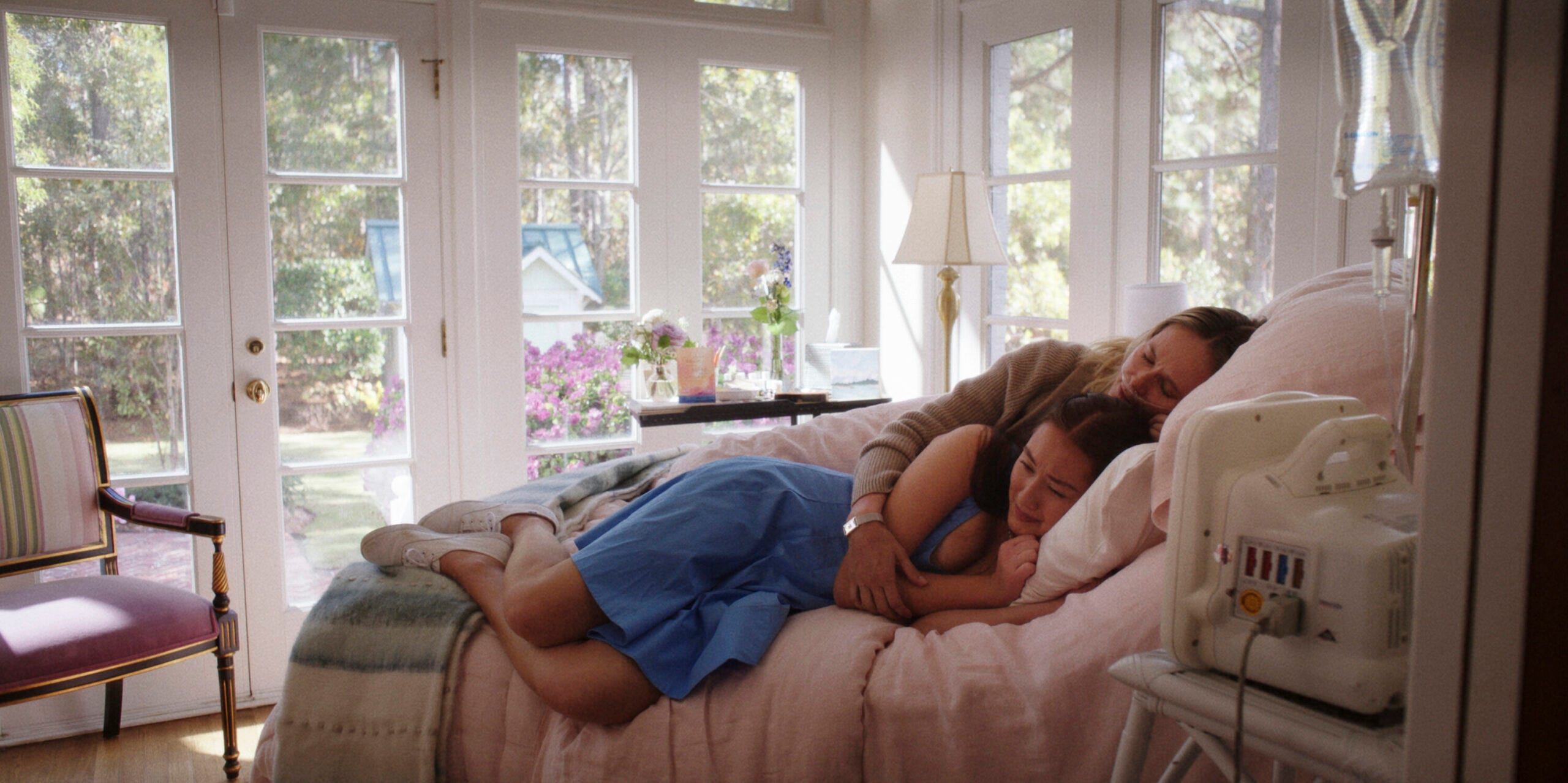
I. Love Triangle
On the third day my mother sickened; her fever was accompanied by the most alarming symptoms, and the looks of her medical attendants prognosticated the worst event. On her deathbed the fortitude and benignity of this best of women did not desert her. She joined the hands of Elizabeth and myself. “My children,” she said, “my firmest hopes of future happiness were placed on the prospect of your union. This expectation will now be the consolation of your father. Elizabeth, my love, you must supply my place to my younger children. Alas! I regret that I am taken from you; and, happy and beloved as I have been, is it not hard to quit you all? But these are not thoughts befitting me; I will endeavour to resign myself cheerfully to death and will indulge a hope of meeting you in another world.”
—Mary Shelley, Frankenstein; or the Modern Prometheus (Chapter III, 1831 edition)
Two mothers: Susannah Fisher (née Beck) and Laurel Park. They’ve been the closest of friends since their college days. Susannah is married to Adam, a prosperous real estate mogul, but is estranged from him at the series’ beginning; Laurel is amicably divorced. Both have two children. Susannah is wealthy through her marriage. Laurel, a writer, is of humbler means, but it gives Susannah great pleasure to share the luxuries she enjoys with her beloved friend. So every summer, Susannah hosts Laurel’s family at her grand holiday house in the seaside town of Cousins, Massachusetts. Susannah brings two boys, Conrad and Jeremiah. Laurel brings a daughter, Isabel (or “Belly,” as her childish nickname goes), and a son, Steven.
The bonds between these six are very close. It would be somewhat absurd for one party to refer to the other as mere “family friends”—they are family, categorically. The town’s name already suggests the nature of the tie the children share, but their intimacy is more often evocative of siblinghood.8 The women reinforce the sense of a sibling bond by behaving like joint mothers of the children. Susannah even calls Belly “our girl,” an appellation we shall soon have cause to examine in more detail. For now it will suffice to stress that when these characters speak of each other as “family,” they are not speaking metaphorically.
Crucial to the family’s holiday tradition is the exclusion of the fathers. The house “doesn’t belong to them,” as Belly puts it, and their entrance is always met with hostility—particularly from the Fisher boys. Consider the fourth episode of the first season, where Conrad’s rare good mood turns dark immediately upon Adam’s unexpected arrival. Paternal intrusions are always met with territorial aggression on the part of the sons. The house is a strictly maternal space which must be guarded against the father’s trespasses.9 Defending the house from the father is necessary to preserve the prime fantasy it offers: namely, the tenuous persistence of pre-Oedipal communion between mother and child. The identification of the Cousins house with a kind of womb is made by Belly herself in her opening narration, when she tells us that she’s been coming to the house since before she was born. “It’s the same every summer,” she remarks. “I’ve always loved that about it.”

Sameness is, in fact, the defining feature of summers in Cousins. The holiday is oriented around the unvarying observance of various rituals: “Belly-flopping,” a first day tradition where the boys dump Belly in the pool; Fourth of July celebrations; movie nights; Belly’s birthday, etc. The children’s intimate relationships are also defined by sameness. Most pertinently, Belly has “always loved” Conrad. In the first episode, the genesis of the crush is dated by Belly’s friend Taylor to the age of 12; but as the series progresses, its inception point moves further and further back, all the way back to the youngest days of childhood. Her love for Conrad is, indeed, identified with her childhood. Childhood flashbacks are likely to intrude at intense moments of romantic yearning or sexual excitement. This pattern only grows more frequent as the series progresses, with the third season featuring the highest quotient of flashbacks to the earliest dates in the characters’ lives. The series establishes a direct line from Belly’s childhood to her mature desires. It concretizes this lineage in two objects, both gifts from Conrad: a cherished teddy bear of her youth (“Junior Mint”) and a necklace with an infinity pendant. These “loaded” objects, to use Taylor’s phrase, continue to trigger intense emotional revelations throughout the series (S3E10). The series’ extreme romantic fatalism springs from its immutable association of romance with childhood memory. The foundation for romantic attraction always originates in childhood, such that romance itself becomes an unconsciously regressive experience. This is no less true for the boys than it is for Belly. “Your hair looks like a little kid’s,” the drunken Conrad tells Belly in the first episode. “It’s always so messy.”10
This state of affairs has endured without serious rupture until the beginning of the series. Two seismic events then expel the children from their idyll: the sexual maturation of Belly and the impending death of Susannah. These trajectories are mapped concurrently across the first season, mirroring one another to melancholy effect. Sex and death form the axis upon which the naïveté of youth yields to the pain of maturity. The security of the ideal family disintegrates, leaving the children to seek out its reconstitution. The nostalgic desire to restore the fantasy of childhood drives all of the series’ protagonists. Even their most damaging actions have this utopian impulse at their base.11

We must now train our attention on Susannah Fisher. We first see her primping hydrangeas in a vase, setting the stage for her guests, and shortly thereafter emerging to welcome them from under a door prominently marked “BECK HOUSE.” Her brisk introduction clearly establishes her as Cousins’ metteur-en-scène. Like any good hostess, her stated goal is simply to ensure the happiness of her guests. This imperative assumes an atypical urgency in the first season, given that she knows this summer will be her last. Faced with the untimely waning of her life, she claims to have only one object in mind: “one last perfect summer at Cousins” (S1E3). What constitutes “perfection”? The reproduction of tradition. Her notion of the perfect summer is modeled on the summers she herself spent at the house with her beloved father. Keeping that sense of childhood delight alive is her ultimate end.
She certainly goes about her agenda assiduously. What is most immediately striking about Susannah, after the charms of her sunny disposition have become familiar, is her utterly inflexible will. As Laurel puts it: “When Beck set[s] her mind on something, that’s it” (S2E7). Susannah seems to agree, describing both herself and Laurel as “immovable objects;” but their mutual obstinacy is often aimed at opposing ends (S1E2). The first argument of the series has nothing to do with romantic competition, but with Susannah’s insistence that Belly, having turned pretty, participate in the local country club’s debutante ball. Laurel, who regards the country club as a “sunken place,” is disgusted by the idea. “I cannot believe you are still holding onto this archaic dream,” she exclaims. Instead of answering the charge, Susannah makes an emotional appeal to Belly: “Don’t you wanna get all dressed up?” In making this appeal, she is just imposing her own desires onto Belly, as she later makes clear to Laurel in private: “I really want to see our girl in a white dress” (S1E1). But the imposition is successful. Despite Laurel’s protestations and Belly’s early doubts, Susannah’s “archaic dream” wins out.12 The gentle but unyielding tide of her intent overcomes all objection. One imagines that many of the traditions at Cousins came about in just this way. Her designs will come to pass, even if the supposed beneficiaries of those designs put up a considerable amount of resistance.
But tradition is a fragile thing. Certain ugly realities threaten to pierce its placid surface. Susannah has a consistent method for dealing with such quandaries when they arise: silence. This too is made clear from the first episode. When Laurel confronts her friend about Conrad’s obvious signs of depression, Susannah has only one, firm response: “There’s nothing to talk about.” A great deal of casual cruelty is concentrated in that word, “nothing.” Maintaining the appearance of happiness takes precedence even over the insistent pain of her children. In point of fact, Conrad is depressed because, unlike his younger brother, he already knows that his mother’s illness has taken a terminal turn. And he knows this in spite of his mother’s best efforts, for she has not informed any of the children that she is dying—in the interest of preserving her perfect summer! She stifles the details of her broken marriage in the same way. Frustrated by the tension between Adam and Susannah at the annual Fourth of July party, Laurel presses the latter till she reveals that Adam has been unfaithful to her: a fact she’s concealed from her loved ones for three years. Upset that Susannah has withheld this information till death’s door, Laurel exclaims “I’m the one who’s going to have to clean all this up,” to which Susannah icily replies “Well, nothing will make you happier” (S1E4). In both of these situations, the ostensibly well-meaning suppression of an unsightly dilemma winds up producing far more suffering through suppression than open discussion ever would have.
Susannah’s cruelest suppression has to do with her own childhood. It is revealed in retrospect by her half-sister, Julia, whose initially unsympathetic qualities reveal themselves to be rooted in a long-held injury. Julia, the first child of Susannah’s father, was always alienated from the happy family he made with his new wife and daughter. The Cousins house was a particular locus of torment: she was forced to spend her summers there (though she “hated it;” S2E4), forced to go swimming (though it “terrified” her; S2E7), and despised by her stepmother, who “could barely stand to look at me” and went so far as to “ask Dad how long I had to keep coming, because I was making everybody miserable”. It was, in a word, “a nightmare”—quite a contrast to Susannah’s dreamy memory of the place. As an adult, Julia attempts to broach the subject with Susannah, only to be met with harsh admonishment. Their father is the initial object of dispute. Julia feels wounded by the patriarch who cast her aside, whereas Susannah recalls nothing but the fondest love. The traces of that love continue well into adulthood, with adverse consequences for Susannah herself. Observing Adam’s shitty treatment of his wife, Julia caustically remarks, to Susannah’s dismay, that “you married our father”: a comment that spells out one of the more plainly self-destructive elements of Susannah’s attachment to the past, and furthermore anticipates the Oedipal romance her children become caught up in. But Susannah refuses to even countenance the parallels between her father’s behavior and her husband’s. She shuts down Julia’s account of her own experiences, too. When Julia expresses her feelings of exclusion, Susannah dismisses her “martyr mentality;” and when Julia recounts her step-mother’s callous words, Susannah outrageously urges her to have empathy for Lillian’s lapse of tongue (S2E7)! “My mom was hoping it would be a chance to clear the air about all the shit from the past. Your mom wanted it to be picture perfect Christmas,” remarks Julia’s child Skye to the Fisher boys. “My mom cried all the way home” (S2E4). This event, dubbed “Shitmas” by Julia, led to the permanent estrangement of the two women. Susannah’s children, beholden to an ideal conception of their mother, offer not the slightest degree of sympathy for their embittered aunt. They only care about saving the house she’s been saddled with selling.
Julia: Your mother could’ve warned you that this was gonna happen. She just wanted to make me the bad guy.
Conrad: You know, it sucks that our grandfather loved her more than you, but I’m not surprised. (S2E5)
Conrad’s harsh remark just reproduces Susannah’s scorn in uglier form. Only Laurel seems to understand Julia’s pain. When Julia eventually expresses shock that Susannah didn’t even call her before she died, Laurel replies, with grim recognition, “It’s not a conversation she wanted to have. With anyone” (S2E7).
The illusion of a “picture perfect” family can evidently only be sustained by ignoring or outright denying a considerable degree of suffering. None of this is meant to diminish the sincerity of Susannah’s goodwill, or to paint her out, in vulgar terms, as a “villain.” The series’ humanist attitude would never stoop to such a diminishment. Susannah truly does want the best for her family—what she feels is best, at any rate. She just doesn’t let the happiness of others get in the way of her good intentions. The implementation of those intentions depends on an intransigent, manipulative determination that is all the more authoritative for appearing so mild, so benign. That determination yields a great deal of joy, but also an equally great (if not greater) deal of misery. Her dreams are paid for in nightmares, her children’s no less than Julia’s.
But we have not yet touched on the dream of dreams, the secret of secrets. This secret is so suppressed that the show only makes reference to it in coded language, but it shapes the entire narrative: Susannah’s romantic love for Laurel. No real declaration of love is ever made. Perhaps the love is not even conscious. But Susannah does love Laurel, more profoundly than any husband. And Laurel loves her in turn. It does not go unseen by those around them. “The only person you’ve ever truly loved is Susannah,” remarks John, Laurel’s ex-husband. “There were three people in our marriage” (S1E7). Laurel affirms this judgment when she later describes Susannah as “my real soulmate” (S2E8). This language may be coded, but it is not subtle. The series consistently stresses that the love between these two women is the greatest either has experienced. This bond, lacking a physical or verbal outlet, finds its expression in the way the women raise their children—share their children.13 In a memoir written after her beloved friend’s death, Laurel recounts a frankly romantic episode from Belly’s birth, over which Susannah lovingly presided:
My daughter, Isabel Susannah Conklin, was born the next afternoon. Beck held my hand the whole time, and when they handed her to me, she said: “There she is. Our special girl.” (S2E8)

The full significance of Laurel and Susannah’s “joint mothering,” to reuse an earlier phrase, can now be appreciated. The love of Susannah and Laurel is consummated in their love for Belly, who they raise together as a daughter without the intervention of their unwelcome husbands. This love is inscribed into Belly’s very name. So the warning Conrad makes to Belly in the pilot—“Don’t let my mom make you her little doll just because she never had a daughter”—is by no means unserious.14 If anything, it does not go far enough: Belly is Susannah’s daughter, in all but the most literal sense of the word. All that remains is to officiate the bond. Belly herself seeks this recognition, because she has been raised to. “Sometimes I wish I was her daughter,” she replies to Conrad.15
How to make the wish come true? The answer is obvious: marry Belly off to one of the boys. This has always been Susannah’s intention for the children. Near the end of the fifth episode, Belly makes a shocking remark in voice-over: “Susannah said that when I was born she knew I was destined for one of her boys.” Allow the totalizing weight of those words to sink in: when I was born. Knew. Destined. This is the language of fate. But Belly’s entanglement with the Fisher boys is not fate. It is a wish, imposed upon the children by a specific person with a specific set of motives. The romantic circuit Susannah establishes for her children, though plainly perverse, has the positive function of resolving, in a displaced fashion, Susannah’s own family conflicts. It both unites her family with her beloved’s, consummating their love through the logic of substitution, and resurrects the ideal family structure of her childhood fancy—all the more ideal for being overtly incestuous. The three children share a common foundation; they have grown up together, with the same set of parents, the same experiences, the same happy memories of Cousins as Susannah herself possesses. Susannah has sculpted their childhood in the image of hers; their love will ensure her childhood’s reproduction. The only coy component of Belly’s remark is the phrase “one of her boys.” As if she would leave room for choice! Though Susannah would never say so, there is, quite unambiguously, only one boy seriously considered for the part. Perhaps she had his destiny somewhere in the back of her mind even before Belly was born, for his middle name is also a variation of her own: Conrad Beck Fisher.
Susannah: I want you to ask Belly to be your escort to the deb ball.
Conrad: Mom, I can’t.
Susannah: Why not?
Conrad: Just tell Jeremiah to ask her.
Susannah: Connie, you know how much it’ll mean to her if it’s you. You’re her Prince Charming, and we all know it. (S1E6)
This exchange speaks for itself. It lays out, in the plainest terms, the object of Susannah’s wish, the roles she assigns (who is “Prince Charming,” who is not), and her indifference to the contingencies that would challenge its realization. What has to be underscored is that this wish has been harbored since Belly’s birth. It is only now reaching its fruition in the children’s adolescence.
Susannah comes close to seeing the realization of her hopes. She is thrilled that Conrad and Belly unite at season one’s end—“I knew it,” she tells them when she first notices (S2E1)—but death cuts her short before she can witness the course of their love. The progress of her death does not go according to plan. Dying is one thing she is “not good” at, she atypically admits.16 The boys themselves are responsible for derailing her death. Once the secret of her illness is out in the open, Susannah’s sons pressure her into undergoing chemotherapy again, a painful ordeal she had sorely wished to avoid. “I can’t go through that again,” she implores, but the boys insist that she “has to.” The devotion she has cultivated in her sons grotesquely backfires on her. A haunting tableau symmetrically positions the boys in her lap, weeping helplessly as Susannah stares blankly ahead in open-mouthed terror (S1E7).17 The composition stages a two-way exchange of love and exploitation. Susannah’s smothering embrace, binding her sons tightly to her in suffering, is countered by the boys’ devouring need for their mother, which will strive to keep her alive even if it means torturing her. The desire of the child can evidently be as authoritarian as that of the mother. Their love has its price, too.
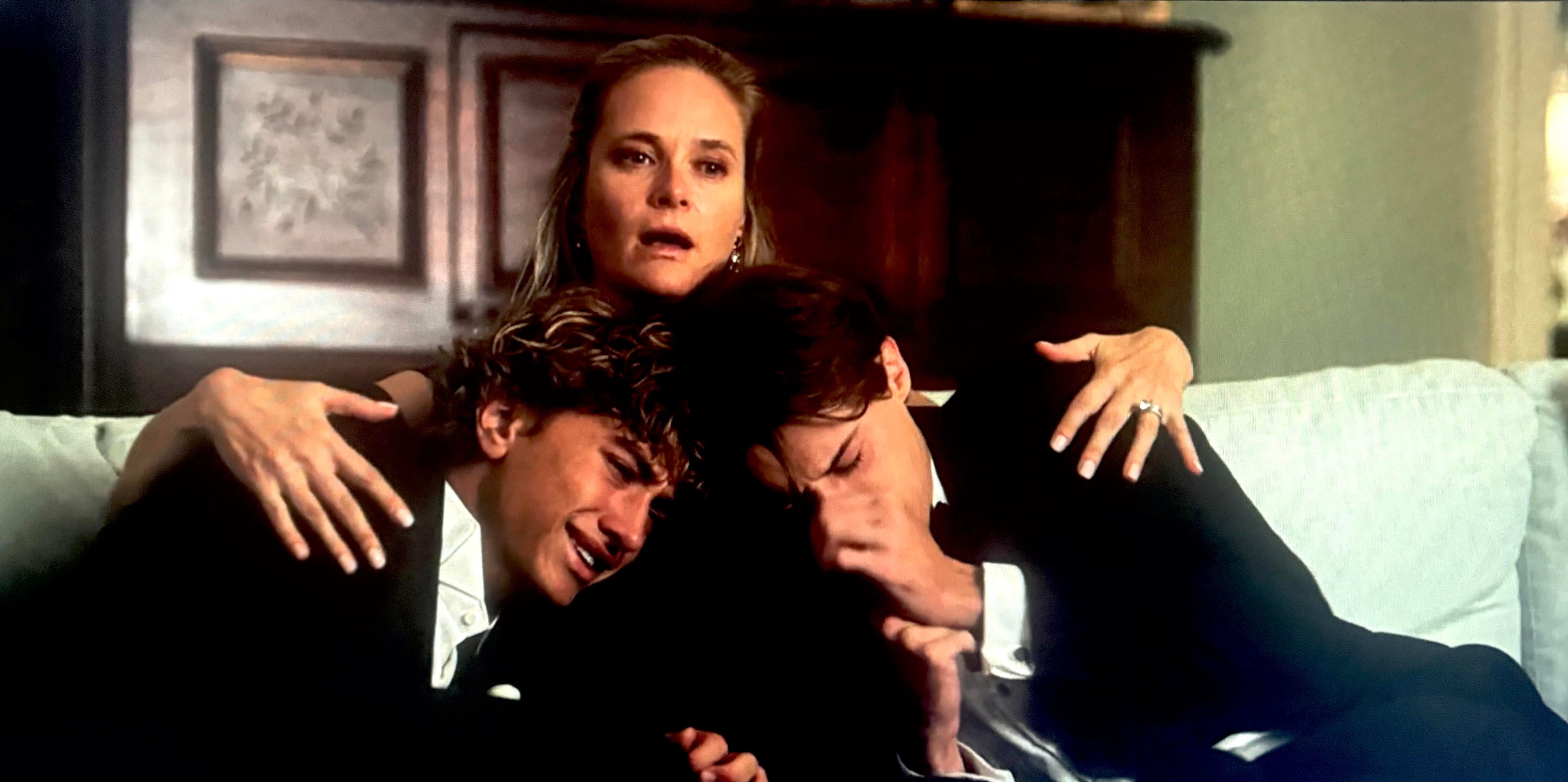
This reluctant persuasion occurs at the end of the first season. It is a cruelly fruitless persuasion: at the start of the second season, Susannah is already dead. In typical melodramatic fashion, however, her power only grows more complete in death. Her name, always recited with affection, attains the stature of a veritable moral law in the subsequent seasons; “It’s what Susannah would’ve wanted” becomes a familiar refrain. Susannah herself carefully lays the foundation for this in the months leading up to her death. In anticipation of her wish’s future fulfillment, she pens a letter to each child, to be opened only on their wedding day. And to ensure her wish’s future fulfillment, she extracts promises from each of the children on her deathbed. The promises are made one by one, in conditions of total privacy. The children keep their promises secret; they never seem to realize that the others have been made to promise too. And each understands that the promises are absolutely binding. “The promises you make on your mother’s deathbed are absolute,” says Conrad. “They’re titanium” (S3E5). Let us list them off in the order in which they are revealed:
From Jeremiah: “Never let anything get between you and your brother.” This promise is extracted after Jeremiah quietly confesses his jealousy of Conrad’s relationship with Belly. It is the only occasion on which Susannah comes close to admitting the wrongness of her intentions (“This is all my fault. I got so excited at the prospect of Belly being with one of my boys”). Her solution, however, is essentially to tell Jeremiah in the gentlest that he has no right to be jealous; his bond with his elder brother comes first. (S2E5)
From Belly: “Don’t hate Conrad. […] Look after him.” This promise is shamelessly extracted after Belly and Conrad have broken up at prom, an experience Susannah sums up with the revealing phrase “Prom didn’t go as we’d hoped.” As Belly breaks down in tears, Susannah insists that Conrad loves her, and pressures her to say it back. (Shades of her treatment of Julia.) “It is important,” she says of the breakup. “It’s the most important. ’cause you’re important. You’re my treasure.” (S2E8)
From Conrad: “You always looked out for [Jeremiah], and you always will. Will you, Connie?” This promise, though similar to Jeremiah’s, attributes a more explicitly paternalistic duty to Conrad: as the elder brother, he has to look out for his immature sibling. (S3E5)
One can hardly fail to see that these promises impute extremely specific roles to each of the children. Belly is bound to care for Conrad, Conrad is bound to care for his brother, Jeremiah is bound not to be upset about it. Those are the ideal terms of the romantic-familial triangle as Susannah sets them. Her will imposed, she dies at peace, leaving her children to clean up the biggest mess of all.18
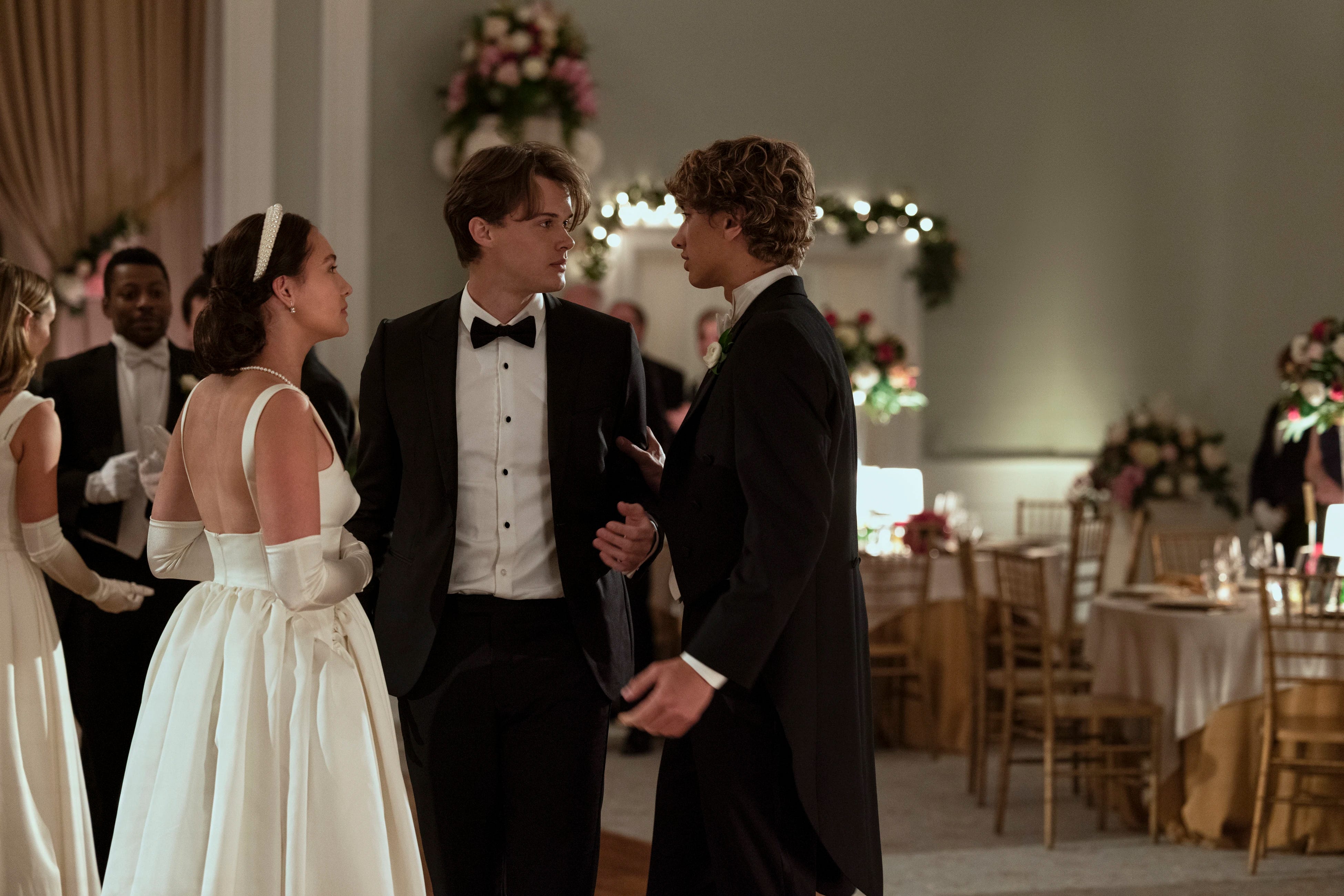
A loving mother’s dying wishes have condemned these children to incest. We know what function their triangle fulfills for Susannah. What are its implications for the children? For the boys, Belly becomes an object of sexual competition. But more importantly, she becomes a maternal substitute. The boys’ attraction to Belly can never be disentangled from their mother’s expectation, repeated to them their whole lives, that they were “destined” to be with this girl. Attaining Belly, Susannah’s “treasure,” means attaining the mother’s approval. After Susannah’s death, the stakes increase significantly: Belly is not merely a prize but a replacement. “Belly’s been the center of my world since my mom died,” says Jeremiah, and the same is true for Conrad (S3E2). The identification of Belly with Susannah is beautifully expressed in a shot-reverse-shot sequence from the season one finale. At the debutante ball, Jeremiah, distraught by his newfound knowledge of his mother’s illness, gazes at an applauding Belly; the camera slowly shifts and pulls focus to reveal Susannah standing behind her, before cutting back to Jeremiah’s pained, yearning eyes. Romantic attraction masks grief for the mother’s loss; consummation with the romantic object implies the possibility of the mother’s restoration. The boys are perpetually encountering echoes of their mother in Belly. They make explicit mention of this association too many times to list. I will cite an example, from a speech delivered by Jeremiah at his wedding rehearsal dinner, that may be taken as summative. “We both miss my mom so much, especially now,” he says. “Belly, you are the daughter she always wished for, and that makes me feel like a part of her is with us now” (S3E8). That precious “part” is what Belly’s love preserves for the boys.
Accordingly, for Belly, Susannah’s design entails becoming the mother. This implication is already present in Susannah’s demand that Belly “look after” her son. But motherhood is not merely a state of subservience; it is also an opportunity to assume the role of metteur-en-scène. Belly is eager to take on that role, even as she recognizes its contingency:
Maybe Julia was right. Susannah did believe Cousins with a fantasy world. But she made me believe too. So maybe I can make sure it stays that way. (S2E3)
This train of thought—perceiving an idea’s falseness, yet holding to it because one was made to believe it—is the predominant psychic pattern in Summer, articulated with ruthless lucidity in the series finale. But we will come to this later. For now, it is enough to underscore Belly’s regressive desire to maintain the “fantasy world” inherited from her mother figure, a desire shared by all the characters. We have already seen that such preservation comes at a terrible cost, and Belly proves even more ill-suited for the task than her predecessor. She is unable to meet the boys’ romantic needs because, unlike the love of a mother, her love comes with conditions. These conditions are defined by her personal caprices, which Susannah could never have accounted for. Nor could she have accounted for the caprices of her sons. The friction between the design imposed on these three by the prior generation and their own unruly natures drives the drama of the series. In order to understand that drama, we must detail the particular deformations of desire in each of the protagonists.

Jeremiah, the youngest brother, gets the short stick in the arrangement. He knows he has always been second in his parents’ affections, despite everyone’s efforts to convince him otherwise. Susannah loves her “sunshine boy” dearly, but with regard to Belly (“the most important” matter), her hopes are clearly set on Conrad, as demonstrated in the previously quoted exchange concerning Belly’s deb ball date (S2E5). That she essentially views Jeremiah as a kind of go-between is made clear as early as S1E5, in which she paints him as Hermes.19 Adam, for his part, openly holds his younger son in contempt. “My dad always loved Conrad better,” Jeremiah says, and the series furnishes abundant examples to support this remark (S2E5).20 Conrad is smarter, more driven, and more talented; next to him, Jeremiah feels hopelessly inadequate. To compensate for the lack of respect his parents accord him, he affects a carefree “party boy” persona. His goofiness, good humor, and incessant flirtation are defense mechanisms based on the conviction that if he musters enough charisma, he won’t have to live up to his parents’ idea of success.21 The love of his numerous admirers will have to reimburse the love denied.
This lighthearted front is all too effective, insofar as it leads others to underestimate the depth of his emotions. Attempting to assuage Belly’s concerns about Jeremiah’s jealousy, Conrad remarks that his younger brother “never takes anything too seriously”—a very grave misjudgment (S2E1). Quite the opposite is the case. Jeremiah has as great an emotional stake in Belly’s love as Conrad does. He tells us that Susannah “was the only person who ever really saw me. Her, and Belly” (S2E5). Recognition is experienced only through the gaze of the mother and the love object. So Conrad’s romance with Belly, preordained by his mother, comes to represent the threat of an ultimate rejection. “I tried to convince myself for a long time that it wasn’t inevitable, that I had a chance.” But his knowledge of the outcome’s “inevitability” cannot quell his abiding sense that he has been dealt an unfair lot and deserves better. Conrad’s sullen, saturnine disposition convinces him that he might yet usurp his brother in Belly’s affections. “My whole life it’s always been Conrad for Belly. But maybe, for the rest of the story, it could be me.” This is the only path by which his lifelong feelings of inadequacy can be resolved. For that vanishingly slim chance, he will risk everything.
He gets his chance twice. Both occasions are marked by paranoia and violence. Jeremiah’s initial pursuit of Belly is initiated when he spies her and his brother from afar, engaged in a private conversation on the dock. To disrupt their intimacy, he shoots a firework in their direction: an unambiguously malicious act of phallic aggression that inaugurates the open rivalry for Belly’s love (S1E4). He is also the first of the sons to plot, steering Conrad back to his summer fling in an attempt to nip his courtship of Belly in the bud. The diversion works, and by episode’s end, Belly, frustrated with Conrad’s evasions, is in Jeremiah’s arms. “I was just waiting,” he tells her: Conrad was always in the way (S1E5). His success proceeds as far as the debutante ball, to which he escorts Belly, in contradiction of Susannah’s privately expressed intentions. But their brief romance is unconsciously haunted by a grim underside: Jeremiah’s exclusion from the privileged knowledge of Susannah’s illness. These two narrative strands are intimately entwined across the first season. Jeremiah and Belly’s first kiss occurs directly after a scene in which Susannah collapses on the staircase of the dark house. Conrad, having witnessed the fall, helps her to her feet. The juxtaposition contrasts Conrad’s knowledge with Jeremiah’s ignorance. Both Susannah and Conrad conceal the illness to preserve Jeremiah’s feelings—a concealment as condescending as it is well-intentioned. He discovers their deception in the middle of the debutante ball, prompting his abrupt abandonment of Belly and emotional breakdown on the lawn. When he returns to the country club, eyes misty with tears, he finds Conrad slow-dancing with Belly, taking his hard-won place. This spectacle is much more than a mere jilting. It is the confirmation of his deepest fear: his mother will die, his brother will love her substitute, his solitude will be absolute. His pain at this perceived dual abandonment propels him into a public fistfight with his blindsided brother. Jeremiah’s anger at Conrad for hiding Susannah’s illness and for courting Belly are functionally indistinguishable. His punches are just the ironic expression of his impotence. Violence is the tantrum of the unloved child.
His second chance, following Belly’s traumatic breakup with Conrad, proves to be of greater longevity. It spans four years, all through their shared time at college. He employs all his charms to woo her, offering himself completely in ways Conrad is unable to do. (He also benefits from her sense of guilt after reneging on him the first time.) And for four years, that offering seems sufficient, to the point where she eventually agrees to marry him. Jeremiah does not take this success for granted. In addition to winning her love, he gains the arguably even greater satisfaction of smearing his victory in his brother’s face. But the paranoia has not dissipated. His fair countenance is frequently shadowed by an anxiety that betrays his lack of confidence in the apparent stability of their relationship. “I wanna believe it’ll be different this time,” he tells her, but “I feel like I’m just waiting for the other shoe to drop” (S2E8). He needles her constantly for promises, reassurances, ever greater vows of fidelity. As soon as he suspects she has broken her fidelity, he is unfaithful himself—a betrayal he apologizes for with an even more desperate gesture of affection (the marriage proposal). But in exchange for his complete devotion, he makes a monstrously total demand on Belly’s love. “I don’t want part of you, Belly. I want all of you. I haven’t had that, not ever” (S3E8). This ultimatum, while extreme and untenable, evinces a real need. He really hasn’t had that love, and his paranoia is justified—the series vindicates it in every respect. The abjection of his position is ensured when, on his rapidly disintegrating wedding day, he opens the letter Susannah addressed to him for the occasion—only to discover Conrad’s letter in the envelope, mislaid by a cosmically cruel mistake. This accident seals his fate. The dreaded inevitability of Susannah’s will consummates itself, leaving the outcast son destitute and distraught.22 A character that might well have been a mere heel or fool instead emerges as the most wretched and pathetic of the main trio.

The essential difference between Jeremiah and his elder brother, Conrad, is concisely epitomized by a tense interaction from the first season.
Jeremiah: I know how much you like to win.
Conrad: It’s not about winning for me. It’s about doing things the right way. (S1E6)
Jeremiah paranoically projects an attitude of spiteful superiority onto Conrad, disclosing his own sense of inferiority in the process. Conrad, by contrast, expresses an overriding obligation to duty. As the “serious” older sibling, a great deal is expected from him. His father fosters great hopes for Conrad’s professional success, while his mother prepares him for the role of patriarch in the model family she designs for her children. Conrad feels an earnest responsibility to meet those expectations. “I just don’t want to let anyone down,” he professes (S3E1). Duty is evident in everything he does: fixing up the house, preparing healthy foods, taking care of his sibling (or rather siblings, since Belly is a sister in all but name) when intoxicated, etc. In this he is much more like his mother than Jeremiah is. Susannah was also moved by allegiance to an ideal. But unlike Susannah, Conrad suffers intensely from his responsibilities. Submission to duty is an exclusively painful experience, the negative inversion of his mother’s commitment to tradition. He inherits the full structure of her thinking without any benefit to himself. If Susannah’s machinations had essentially utilitarian aims (fostering the happiness of the family by any means necessary), it is hard to see what Conrad’s dutiful behavior gains for him or anyone else. He hurts his loved ones grievously in the commission of what he believes to be his duty, and hurts himself even more. His apparent vices always conceal an inner sense of virtue, but it is virtue without value. He does not even allow himself to reap the reward of pride, for he works hard to conceal his sacrifices from others, and privately considers himself “a fuck-up and a failure and a disappointment” (S3E6). His sense of failure springs from the contradictory duties Susannah has burdened him with: first, to be “Prince Charming” for Belly, and second, to “look out” for Jeremiah.23 Since Jeremiah’s self-worth is intrinsically bound up in Belly’s approval, there is no way to satisfy both of these demands at the same time. Being with Belly means hurting his brother; looking out for his brother means hurting Belly. Conrad’s erratic behavior is a result of his alternating attempts to resolve this impossible double bind.24 These attempts usually entail extreme self-effacement. The only pleasure such behavior could produce is masochistic.
Conrad is consequently the most neurotic of the main three. Susannah’s propensity for secret-keeping acquires a compulsive character in him: keeping secrets is “my thing,” he tells us (S3E6). In the first season, he conceals the cause of his depression (Susannah’s impending death) from everyone who tries to help him. He does not do this to sustain his mother’s “perfect summer,” but to gratify a far more extreme compulsion. “If I just keep it inside,” he confesses to the writer Sebastian Castillo, “maybe she’ll stay alive.” Sebastian recognizes the compulsion immediately: “You’re afraid to step on a crack” (S1E6).25 This is the structure of obsessional neurosis. The same principle applies to Conrad’s two other major secrets: his knowledge of his father’s infidelity;26 and his love for Belly, which he must suppress in order to clear the way for Jeremiah. After discovering Jeremiah and Belly’s relationship in the season two finale, Conrad spends a tortured evening wrestling with his conflicting commitments (to love Belly, to “look out” for Jeremiah), before deciding that his “titanium” promise to Susannah must take precedence. The next morning he denies his love to Belly (“I just want you to know whatever I said, I didn’t mean it”), allowing the new relationship to proceed at the expense of his honesty (S2E8). This is, he feels, the only lie he ever tells (S3E10). Maintaining the lie requires a considerable mutilation of his own impulses. Some deep part of his being protests against his sacrifices. The suppressed pain symptomatically asserts itself in panic attacks: on Castillo’s boat, fearing an “infection” whose spread he “didn’t notice” (S1E6); at his mother’s funeral (S2E5); and after he gets accepted to Stanford, the college Susannah always wanted for him (S2E3/4). He copes with these feelings by converting hatred into self-hatred. Witnessing the embrace of Jeremiah and Belly, he thinks “I would rather have someone shoot me in the head with a nail gun repeatedly than have to watch him touching her like that all night” (S3E5). Because the thought of hurting his brother is inadmissible to his dutiful conscience, his aggressive impulse against Jeremiah is masochistically redirected toward his own person. Where Jeremiah vents aggression on external targets, Conrad’s violence is wholly internalized.
That violence surfaces in various forms of paralysis. Conrad inflicts damage by failing to act. In season one, his silence about his mother’s illness culminates in open conflict between himself and his brother. In season two, his romantic relationship with Belly becomes deeply strained during the last months of his mother’s illness. Rather than talk to Belly or his mother about his grief, he becomes withdrawn and depressive. His aloof behavior eventually provokes Belly to dump him at prom. “Technically she broke up with me,” he later confides, “but I basically teed it up for her” (S3E1). In other words, he provokes aggression against himself through his passivity. He never stops paying for this event, which everyone seems to hold against him. But he refuses to advocate for himself in turn. When Belly spots him alone with one of his exes at his mother’s funeral and, paranoically, assumes that he has already found a new girlfriend, he doesn’t push hard against her misinterpretation, but further goads her anger (S2E3). He speaks cruelly in order to totalize their separation from one another, which he sincerely feels is the right thing to do.27 Conrad’s displays of cruelty always have a compassionate conviction at their base, and they always come at his own expense. He does exactly the same thing when he denies his love so that Belly and Jeremiah can be together. After that, he is glad to flee to the other side of the country for his college studies (S3E1). All the better to get out of their way. But he is not free from his obsession, even if he cannot speak it. Despite the attentions of a flirtatious colleague, he pursues no other sexual or romantic relationships. In therapeutic sessions, he is literally incapable of uttering Belly’s name aloud—it is quite uncertain whether the therapist even knows of Belly’s existence. He carries an obsessive anxiety of returning, four years later, to Cousins and to his family. He fears that, by his very presence, he will bring about disaster.28
So when he does return, he persists adamantly in suppressing his feelings. When Belly and Jeremiah announce their engagement to the horror of their friends and families, Conrad is the only one to voice no objection, simply sitting in stunned silence (S3E3). Indeed, in the weeks to come, he actively enlists himself in service of the wedding; it is he, not Jeremiah or Belly, who convinces the incensed Laurel to attend (S3E6). And he holds that silence right up until he can no longer bear it—the very night before the wedding day, when the discovery of Jeremiah’s infidelity prompts him to confess his feelings to Belly. In this we recognize another bad habit of Susannah’s, who kept her secrets until the moment at which they were primed to do the most harm. But Conrad’s long-delayed self-exposure, while highly destructive in its immediate effects, has ultimately redemptive consequences. He is only able to overcome his suffering by speaking the unspeakable: his love for Belly and his hatred of his brother.
Conrad: Fuck, I still love you. I don’t think I’ll ever get you out of my system. You will always be there, (gestures to heart) here. […] I love Jeremiah. He is my brother, he is my family. And I hate myself for doing this. But when I see the two of you guys together, I fucking hate him. (S3E7)
Obviously this confession seriously wounds Belly and Jeremiah both. But it is Conrad’s salvation. Had he kept his silence, he would’ve hated himself to death.
We have now seen how Susannah’s designs produce different constellations of neurotic behavior in her sons: the younger brother paranoid and insecure, the elder guilty and masochistic.29 Both of these brothers feel they need Belly, the maternal substitute, to lend meaning and purpose to their lives. They could not have found a worse person on which to hinge their hopes. (Then again, they were not afforded the chance.)

Belly’s fundamental flaw is identified immediately. Discussing her lifelong crush on Conrad in the first episode, she is admonished by Taylor for hesitating to declare her feelings. Taylor sets down a simple mandate for her friend: “Shit or get off the pot.”30 This is exactly what Belly refuses to do for the remainder of the series. At times, her myopia is maddening to witness. She initially pursues a romance with Conrad; then, when he proves too moody, goes on a few dates with local straight-edge Cameron before shacking up with Jeremiah. When Jeremiah flakes on her during the debutante ball, she flips back to Conrad instantly; they are a couple as of the next morning. They stay together till spring of the following year, when the prom debacle occurs. Only two months later, she is back with Jeremiah. She stays with Jeremiah for four years. They have one serious argument, which results in Jeremiah cheating on her during a brief “break” from their relationship. When she eventually discovers his infidelity, she threatens to break up with him. She avoids him for a full day to mull it over. When they next see each other, she not only forgives him, but assents to his proposal of marriage! The night before the wedding, she feels an overwhelming impulse to return to Conrad, but reacts furiously when he declares his love the very same evening. The next day, however, she does break off her wedding; then flees both brothers to live in Paris. A year later, she returns, finally decided, to Conrad.31
How to explain such extreme inconstancy? If the boys’ patterns of behavior are fairly consistent, based in a single psychic structure established in early childhood, Belly’s behavior proves a far knottier affair. There are a few distinct desires feeding into her propensity for vacillation. I have already alluded to the most apparent: the pleasure of playing metteur-en-scène. Belly is a shy sort at the series’ start, but she quickly comes to appreciate the power of having “turned pretty,” a power she has never known before. She does not experience the brothers’ competition for her as placing her in a position of subjection, but of pleasurable empowerment.32 This pleasure is never truly concealed. Taylor is quite aghast when, mere hours after kissing Jeremiah, Belly beams with delight upon receiving an amorous text from Conrad (S1E6). She cannot be begrudged for her adolescent delight in being desired for the first time.33 But since she is such an absolute figure of value for the boys—her approval, as we already know, holds sway over their entire lives—her delight rapidly metastasizes into narcissism.
There is no doubt that the demands placed on Belly by the Fisher boys are unsustainable and excessive, or that they treat her unfairly (to say the least) in the pursuit of those demands. Belly, however, behaves no less unfairly. What she demands from her brothers is that they surrender themselves to her completely—that they never center any needs but her own. That means that her predecessor and model, Susannah, is also her primary competitor. Susannah is the only person the boys value as highly as Belly, so their feelings for her pose a risk to Belly’s sovereignty. The big arguments of her relationships always circle back to the boys’ grief for Susannah. She breaks up with Conrad at prom because his grief renders him incapable of completely attending to her desires; the fact that her prom goes poorly is significantly more important to her than understanding or empathizing with why Conrad might be behaving this way. At the funeral, when she witnesses him in the throes of a panic attack, her immediate impulse is to become jealous:
Conrad: Belly, that was just Aubrey.
Belly: Sorry to interrupt your little moment.
Conrad: She was helping me.
Belly: So you’ll accept her help but not mine? Got it. Glad to know where I fall in the ranking of ex-girlfriends.
Conrad: Grow up.
Belly: Go to hell! (S2E3)
Belly is being willfully disingenuous here, to say the least. It is true that Conrad won’t let him help her, but she has no real interest in “helping” Conrad negotiate his grief—that much is already evident from prom night. The dispute isn’t even about Audrey specifically. The reason for her anger hasn’t changed since the break-up: she cannot tolerate Conrad’s grief for Susannah eclipsing his devotion to her. Her first big fight with Jeremiah is colored by a similar jealousy. The argument’s inciting subject is Belly’s discovery that Jeremiah has booked a flight to Cabo without telling her, but the underlying issue is Jeremiah’s “moodiness” since seeing his father the previous weekend. When Jeremiah irritably explains that he had visited his mother’s grave, Belly replies “I think you’re being a little bit selfish” (S3E2). Predictably, this argument drastically aggravates Jeremiah’s insecurities, for which Belly has no patience.34 Both of these incidents go beyond mere insensitivity. They demonstrate that Belly is envious of the love the boys have for their mother.

Romantic success with Belly consequently depends on one’s willingness to marginalize all other significant emotional commitments. Her desire for sovereignty means that, even though Conrad is the one she has loved all her life (and the one for whom, we must continue to stress, she has been intended for her whole life), Jeremiah proves the more appealing prospect for most of the series. Jeremiah knows that he’s lucky to get anything from Belly at all, and he has no difficulty performing the part of the “fun,” easygoing boyfriend to please her whims: it’s a performance he’s cultivated all his life. Conrad, with his gloomy sense of obligation and reluctance to please, is far too demanding; whereas Jeremiah is more than willing to flout all obligations for Belly, especially family obligations, since his family has never given him the respect he feels he deserves. The two declare their engagement at a lunch following a memorial event for Susannah, thus marking the second occasion on which Belly disrupts an event dedicated to the deceased matriarch. When the family reacts in shock and indignation, they receive only indignation in return; Belly flashes her engagement ring at Laurel like she’s flipping her the bird (S3E3).35 This is childish behavior indeed, but then again, that is precisely the charm of Jeremiah: unlike Conrad, who demands that Belly “grow up,” Jeremiah will allow her to continue being a child with him. The basic unseriousness of being with Jeremiah allows Belly to make drastically serious, even self-destructive commitments to him. These commitments extend well beyond marriage. She actively endeavors to rewrite the history of her desire with Jeremiah in Conrad’s place. The interchangeability of the brothers as love objects is initially suggested in a dream Belly has after kissing Jeremiah for the first time: lying in bed, Conrad turns into Jeremiah (S1E6). By the start of the third season, there are signs that her mind is attempting to efface Conrad completely. “It felt as if it had always been this way,” she says of her love for her “soulmate” Jeremiah, using the same language she once used for his brother (S3E1). She even misremembers a beloved childhood incident: the discovery of Rosie the dog, which she attributes to Jeremiah until he and Steven remind her that it was Conrad who found the dog (S3E6). The fact that Belly is sincerely shocked to hear this indicates the extremity of the repression at play.
Her substitution doesn’t succeed. Try as she might, Belly cannot tame the libidinal drives of her childhood, inscribed long ago by the inevitable will of Susannah. When Conrad returns to Cousins, his sheer erotic pull proves too powerful for Belly to withstand. He has the full force of her childhood behind him, the force of infinity; the call to be with him compels the very core of her being.36 The night before her wedding, she is suddenly inundated with memories of Conrad, driving her to confess her ambivalence to Taylor. “I never even had a dream wedding. It wasn’t like this,” she sobs. “I never pictured any of it. I only ever pictured Conrad” (S3E7). The revelation doesn’t prevent her from rejecting Conrad’s confession of love a few hours later. She tries to reimpose the regime of silence (“Don’t say it;” S3E7), but becomes angry when he offers to “forget about it” the next morning. “Don’t say my name,” she yells, “don’t even think it—you know what, don’t ever speak to me again.”37 Conrad, finally sick of playing the doormat, refuses to accept her command.
Conrad: You broke my heart last night, Belly, is that what you want to hear?
Belly: You really are heartless.
Conrad: No. I think it’s you who’s heartless.
Belly: What is that supposed to mean? Tell me what you mean by that!
Conrad: You know what I mean by that. I love you. I will never not love you. I think you know that. I think you’ve known all along.
Belly: That’s not true.
Conrad: Yes it is.
Belly’s denials lack the force of conviction. She knows that the game is already over, and the rest of the episode just charts her futile attempts to stave off its catastrophic consequences a little longer. She eventually capitulates to what she knows to be true. As the anguished Jeremiah acknowledges, “You can’t marry me to erase him” (S3E8).

Belly is terrified by the intensity of emotion Conrad inspires in her. She is terrified of big emotions in general: “Real is scary,” as she puts it. What comprises the “Real”? On the one hand, sexuality, as when she remarks, the morning after her initial romantic encounter with Jeremiah, that the kiss is “invading everything” (S1E6).38 Her avoidant behavior with regard to Conrad in the weeks leading up to the wedding is also a clear indicator of this anxiety. On the other hand, the “Real” encompasses death. Belly resists visiting the dying Susannah until she is forced to go by her mother, because seeing Susannah sick would “make it real” (S2E8). We can assume that when she acts insensitively toward the boys’ grief, she is not merely reacting in jealousy (though jealousy certainly plays its role), but also admonishing them for expressing an emotion she is suppressing in herself. In a rare moment of unguarded clarity, she expresses solidarity with Laurel’s suppressed grief:
Laurel: I didn’t let myself feel it…because if I let it out…
Belly: …then all the other stuff would come out too. (S2E7)
The frightful emergence of “the other stuff”—namely, love and death—menaces Belly at every turn. The inception of her anxiety is dramatized in a remarkable flashback (S3E4). Twelve-year-old Belly is granted her own bedroom by Susannah. “Big girls need bigger beds and bigger rooms,” Susannah smiles. “What about the boys?” asks Belly. “Oh, you don’t want to keep sharing a room with those stinky, loud boys,” Susannah replies. The onset of puberty necessitates the gendered separation of the children. That night, Belly is frightened when the boys knock on the walls of the bedroom and imitate ghosts. This is the ominous moment at which pubescent sexuality first becomes a palpable presence for her—the “other stuff” is striving to gain entry. She goes downstairs and asks Laurel to sleep with her. They return to the bedroom and sleep serenely. The mother’s embrace has provided security from the perils of maturity. Cut to the present: Belly is alone in her bedroom, a “big girl” now but no less afraid, without her mother’s support. The regressive desire for the mother is still powerfully felt, but it receives no satisfaction. She curls up on the bed and sobs.39 Conrad silently peeks his head into the room. Witnessing her pain, he reclines his head in sorrow against the frame of the door. But he does not speak.40


We can now understand that Belly’s refusal to commit is an attempt to hold love and death at bay. The endless drama of romantic choice continually defers her encounter with the “Real.” Childhood games are extended into the realm of adolescent sexuality, only now the games have real stakes for all involved: stakes whose magnitude Belly intuitively understands, but constantly refuses to contend with, because contending with them would mean maturing.
In case I have painted our heroine too unsympathetically, I hasten to remind the reader that the fear of maturity is common to all the characters in Summer, including the adults. (Susannah, as we have seen, certainly had plenty of “other stuff” of her own to keep at bay.) But because Belly exists at the nexus of the romantic triangle, her immaturity has the most destructive consequences. Above all else, her behavior results in the total death of the language of the promise. In contrast to the titanium promises of Susannah, Belly’s promises mean less than nothing. This is most keenly felt by Jeremiah, who is constantly seeking a certainty Belly insincerely offers him—without even being conscious that she is speaking insincerely. Time and time again, he begs her to tell her true feelings, and time and time again, she reassures him that there’s nothing to worry about:
Belly: There’s nothing between me and Conrad.
Jeremiah: There’ll always be something between you and Conrad. (S2E7)Jeremiah: Belly, if I fall for you again, I don’t think I can take it if you change your mind like last time.
Belly: I won’t do that. It’s different now. (S2E7)Jeremiah: What happens if—when—Conrad finally admits how he feels about you?
Belly: It won’t change anything. (S2E8)
These interactions (and I have only selected a few) have the horror of a slowly unfolding trainwreck. Two people with extremely different needs meet in a false unity they both know will never last.41

We find in Jeremiah and Belly’s relationship a sterling example of the “vicious circles of substitution and frustrated desire” scholar Thomas Elsaesser identifies as characteristic of “critical” melodrama.42 A vicious circle also runs between Belly and Conrad. Conrad’s demonstrations of love for Belly (his willingness to let her go at the end of season two, for instance) necessitate the denial of his love, which Belly invariably takes at face value because of her myopia. And another vicious circle runs between Conrad and Jeremiah, in some ways the most vicious of all. Consider the following interaction from the most violent scene in the series: Jeremiah flees his wedding ceremony to weep at Susannah’s memorial, where he is discovered by his brother.
Conrad: Do you wanna hit me? It’ll make you feel better.
Jeremiah: No, it’ll make you feel better. (S3E8)
And of course Jeremiah punches him anyway. The exchange has the elegance of a bleak joke. It pivots on a perverse complementarity between the boys’ neuroses, Conrad’s need for punishment finding its satisfaction in Jeremiah’s desire for aggression. One of Summer’s bitterest truths is that the needs of its characters intersect almost exclusively in mutually painful ways. The basic constitution of their personalities makes the generation of vicious circles inevitable. Even when not emerging in overt violence or anger, the conflict between their competing needs informs virtually every interaction the three share. During one of the vanishingly brief windows of calm in which no brother is dating Belly, they all agree that they never want to hurt one another again, but Belly soberly observes “I don’t know if it’s something we can control” (S2E7). It is not something they can control, because there is simply no way to resolve the triangle Susannah has established between them without someone’s needs going unfulfilled, someone getting grievously hurt.
The series takes great pains to establish each character’s needs as coherent and legitimate. This approach typifies what Elsaesser calls the “‘liberal’ mise-en-scène” of melodrama, “where each character has his reasons, and however briefly, even the villain’s point of view seems justified.” All points of view in Summer are eventually shown to be justified, or at least sympathetic, by the circumstances in which they came to be. Even Susannah, the architect of so much unhappiness, seeks the fulfillment of a sympathetic need.43 The series reveals its characters’ motives through strategic shifts in point of view, fostering both identification and suspense. “Restricted narration is the motor of melodrama as a critical genre,” says Elsaesser, “be it in the mode of pathos or that of irony.”44 Restricted narration is an important structuring element of Summer: Belly is the series narrator, while Jeremiah and Conrad each get their own point of view episode (S3E5 and S2E5 respectively). But shifts in identification are not solely dictated by who is narrating. The more fluid logic of the flashback takes greater precedence. Flashbacks are deployed to radically revise our understanding of prior events (e.g. Julia’s flashback to Shitmas, S2E7; Belly’s flashback to Christmas, S3E2; Conrad’s flashback to the motel, S3E6;), to establish intense emotional contrasts between the past and the present (intercutting between Belly’s return to the vacated Cousins house and her first sexual encounter with Conrad; S2E2), or even to evoke the presence of forbidden temptations (when alone in the house with Belly, Conrad spontaneously recalls the last time they had sex; S3E5).45 There are also the numerous aforementioned childhood flashbacks—perhaps the most significant, since they reveal the seeds of present-day conflict to already be incipient in the distant past. Summer’s flashbacks are constantly reminding us that every event has its its underside, its painful contradictions. These reveals are staggered throughout the show, so that the full meaning of certain events does not become apparent till well after their original dramatization. The gradual revelation of what has already happened proves as great a source of tension for the viewer as the events that will happen. Appearances continually invert themselves through retrospective revision, transmuting vicious actions into virtuous ones and laying bare the tortured “reasons” for all the protagonists’ actions.
This mode of narrative organization is perfectly appropriate for a world literally mired in memory. The series’ logic of repetition and reversal ensures that even the most mundane actions accumulate the colossal weight of one’s entire personal history.46 The reverberations of childhood, its deepest desires and longest-held grudges, adhere to everything these characters say and do. Most of all, there is the memory of the mother. Her presence seems to permeate the very walls. “Here at the beach house, she’s everywhere…and nowhere,” says Belly (S2E3). The luxurious summer house becomes suffused with Gothic claustrophobia.47 The world of the past constricts the children on all sides, propelling them into ever more wounding collisions.
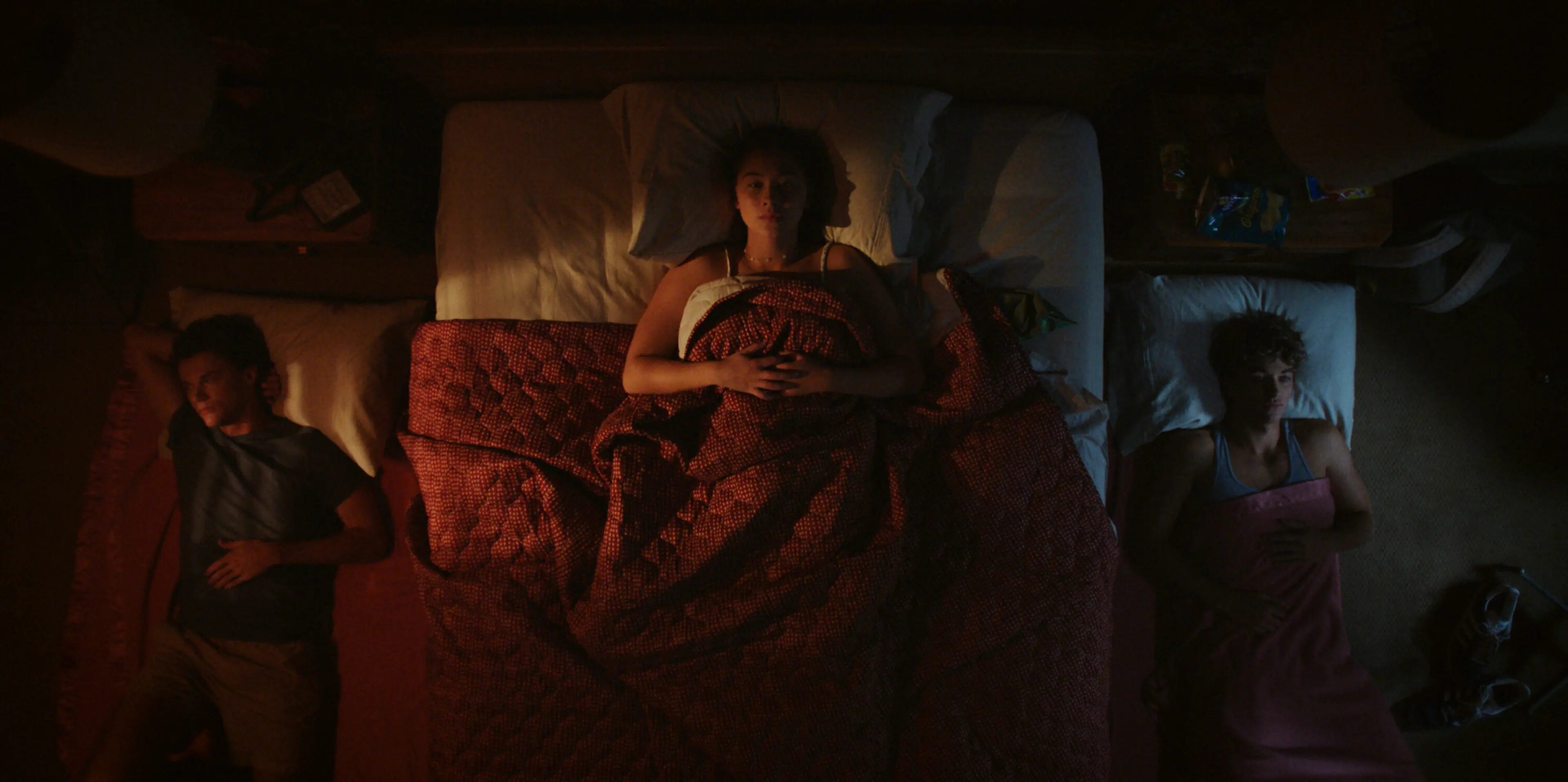
Is there any hope of liberating oneself from memory? After the wedding falls apart, Belly puts geographical distance between herself and Cousins, breaking for a short while the vicious circle that binds the three together. Her removal from the brothers’ immediate environment puts an end to active conflict. Secure in their mutual feelings of romantic defeat, Conrad and Jeremiah eventually arrive, after a year’s long and painful passage, at an uneasy détente. And during that time Belly finally “matures”: she lives independently, makes new friends, finds a new sense of style, even a new boyfriend.48 (Benito is only the second man she’s dated who she has not known her whole life.) Residing in Paris allows Belly to gain her footing as an adult. The pull of Cousins seems to fade. She feels she is no longer the person she once was.
You can therefore imagine her surprise when, on the day before her 22nd birthday, Conrad turns up at her doorstep. During the past year she has received some letters from him—thoughtful, transparent letters, with no trace of romantic presumption—but he gave no indication that he was visiting. He tells her that he’s attending a medical conference in Brussels and arrived a day early; recognizing the happy coincidence of her birthday, he decided to swing by. If she’s free, he hastens to add. He doesn’t want to place an undue obligation on her. The interaction is initially awkward but cordial, and Belly, for the first time, dutifully plays the good host: she shows him around the city, takes him to all the tourist spots, fills him in on the details of her new life and its daily routines. He listens attentively, curious and impressed. He’s truly happy that she seems to have found such fulfillment here.
All the while something is slowly building. Inevitability is setting in. They sense its pressure and fear it. So they circle one another very cautiously. At the Louvre, a 180-degree camera movement charts a subtle roundelay of furtive glances. Belly and Conrad face the same wall. Then Belly turns around to look at the painting on the wall behind her. Slowly, Conrad turns to face the same wall, but his gaze delicately shifts from the art to Belly herself. His eyes flick back and forth a few times, but it’s Belly that holds him, not the painting. Yet when Belly turns to look at him, he looks sharply away. The camera continues to move. The gazes don’t meet.

Yet by the time they’ve arrived at her birthday party, she really is starting to enjoy his company. She’s remembering what she admires about this person. And her friends are thrilled to meet the handsome American about whom they have heard so much. At a candlelit dinner, they debate the meaning of Conrad and Belly’s story. One friend finds Conrad’s deeds “quite romantic,” while another thinks they’re “fucked-up.” The answer is, of course, a bit of both. “It’s like something out of a movie,” remarks a third friend—a movie that divides the audience. But who is the “villain” in the movie? The churlish Benito thinks it’s Conrad, but Belly condemns herself instead. (Later in the evening, Belly and Conrad debate the question between themselves. They both feel themselves to have been in the wrong. They confess their faults, apologize, forgive one another. No-one could have behaved otherwise.) Benito is churlish because Belly dumped him only six weeks ago. Why? You may already be able to guess: “I wanted to take Isabel to Mexico with me to meet my grandmother, but, uh, she shot me down.” Evidently mother love is still an obstacle for Belly. She consoles him all the same: “you’ll always be the boy who taught me how to ride a scooter.” And then Conrad, suddenly emboldened, interjects: “Hey, I’ll always be the boy who taught you how to ride a bike” (S3E11).
There it is. How can anyone compete with that? A love found in adulthood cannot match a love one has carried since childhood. Their histories are embraided into one another, their memories inextricable. Every movement stirs up a fresh recollection. And remembering is no longer frightening, but plainly arousing. The two take obvious pleasure in stimulating memories of childhood in one another. Memory becomes a form of seduction. When Belly takes a joint, Conrad reminds her of when she chastised him for smoking so many summers ago, a scene represented in the first episode of the series. She quotes his own words from that moment in turn: “Do you remember every little thing I’ve ever said?” And when she bends her head low over the blazing candles on the birthday cake, raising her eyes to meet his with a broad smile, we know that the memories of every birthday she’s ever spent with him are embedded in this moment. Slowly they sink into the familiar warmth of their shared history.
The evening ends, as it must, in passionate sex. But after the lovemaking, Belly is suddenly haunted by anxiety. What is Conrad doing here, anyway? And why on earth did she sleep with him? Tentatively, in halting questions, she begins to put the great issue of her life into words. This dialogue is by far the most important in the series, so it is worth reproducing at length:
Conrad: You don’t love me anymore?
Belly: I’ve always loved you. That’s the problem.
Conrad: I don’t really think that’s a problem.
Belly: How are we supposed to know if we love each other because we want to and not because we were told to?
Conrad: You think that I love you because when I was six years old my mother thought that we should get married?
Belly: No—that’s not—that’s not what I mean, I just—I mean—if your mom hadn’t gotten sick again, would we have even gotten together? […] If we didn’t lose Susannah, would it loom so large for us? What if—what if you only love me because that’s what your mom wanted, and then your mom died?
Belly is striking at the heart of the series’ conflicts. Her initial awareness of “the problem” springs from the permanency of her love for Conrad. She does not experience her love for Conrad as part of her conscious will. She seems to possess no agency over it, no power of restraint. It repeatedly overrides her intentions, and it has always done so, ever since the early days of childhood. The “problem” is therefore the friction between what we think of as our free will and what Freud termed the drives. Belly’s love for Conrad is a powerful compulsion in her unconscious over which her ego exercises no authority. The same is true of Conrad’s love for Belly, and of Jeremiah’s. Horror of the drive is endemic to all three. “I don’t know how to not love you,” Jeremiah sobs on his disastrous wedding day. “Even now. That’s the worst part” (S3E8).
But there is a yet “worse” layer to the problem. Belly fears that the drive may have originated elsewhere—that her desires are someone else’s desires, assimilated during her upbringing into the constitution of her unconscious. Rather than being born from her own subjectivity, Belly’s love for Conrad has its origins in the contingent circumstances of her childhood. It did not appear “naturally,” whatever that might mean, but was shaped by the particularities of her family situation. Most of all, it arose from maternal expectations. Susannah’s hope for Belly becomes Belly’s greatest hope. Her desire, to put it bluntly, is the desire of the Other: more specifically, the desire of the mOther. Realizing this induces an experience of alienation. How can her actions be determined by such a powerful drive when she lacks identity with the drive’s source? The possibility poses a profound threat to the autonomy of the ego.
When Conrad formulates her suspicion in explicit terms, Belly reflexively resists it: “that’s not what I mean.” But only a few lines later, it becomes apparent that that’s exactly what she means: “What if you only love me because that’s what your mom wanted, and then your mom died?” Another layer to the problem surfaces. Conrad’s love for Belly may be a transference of his love for his mother, a form of resolving his grief for her loss. If Belly fears the presence of the mother’s desire in herself, she fears the desire for the mother in Conrad.
As we all know by now, Belly is completely correct in every one of her deductions. The series has unfailingly shown this to be the case. The triangle between her and the Fisher boys was brought into being to satisfy Susannah’s desires, themselves produced by the dissatisfactions of her own emotional life. The children are born into the history of her desire, which immediately assimilates them and structures their subjectivities from the foundation. The experience of pleasure and pain itself is defined through the terms set by this primal family structure. All of the children’s greatest joys and bitterest sorrows emerge from the needs it imposes.
What can Conrad say in response?
Conrad: That is not why I love you. I have tried everything not to love you—for the sake of Jere, for the sake of—not dragging you down with me in my grief. I have fought it, way before the summer that my mom got sick. You’ve always been a precious person to me, I’ve always cared about you. […T]he way that I feel about you, Belly, has nothing to do with my mom. If I met you for the first time tonight, I would love you.
Belly: Come on, Conrad. I mean, how do you know that?
Conrad: Because I’ve changed everything about myself, and the one thing that never changes is that I love you.
Conrad admits the compulsive power of the drive which he has strived hard to repress, but adamantly rejects the link between Susannah and Belly. His rejections follow the same law as Belly’s insistence that “that’s not what I mean.” An inadmissible thought (Oedipal desire) finds expression by way of a negative assertion. The very fact that Conrad needs to reject the suggestion in such strong terms attests to its unconscious truth. We may take Conrad’s firm denial as the most damning confirmation of what he denies: the way he feels about Belly has everything to do with his mom. But he has to repress this fact. He cannot admit it even to himself. The disgust and horror its acknowledgement would provoke is too threatening. It could have disastrous consequences not only for his relationship with Belly, but for his entire sense of self. So he has to tell an absurd fairytale: “If I met you for the first time tonight, I would love you.” In a series which consistently identifies the experience of love and desire with memory, this statement can only register as a ludicrous lie. But accepting the lie is necessary to preserve the ego. Conrad has to position his love as existing outside of time and space to avoid contending with its incestuous genealogy.
Belly wants to accept the lie. Yet her doubt proves too powerful. “I wish that I could be as sure as you,” she sighs, “but I can’t.” Conrad leaves her apartment in despair. The threat of incest has obstructed the consummation of the heterosexual couple.
Until, that is, Belly opens a text from her mother. It’s a birthday text, and it arrives with a picture of Belly in her toddlerhood. The picture inspires a sentimental impulse in her. She walks across the apartment and takes hold of the teddy bear Junior Mint, the “loaded” object of her childhood. Her thoughts unfold in voiceover:
Belly: All this time I wanted to believe I’d changed, that I’m not the same girl I was. But I am still her. And was that girl so bad? She followed her heart no matter what. And despite all her mistakes, I have to believe she’s still worthy of love. I still love her. And I still love him. I have brown hair and brown eyes and I will always love Conrad Fisher.
Belly’s decision to return to Conrad is prompted by a regressive identification with her childhood self. It’s as if her hard-won maturity has been instantaneously wiped away. She is “the same girl” after all. There was never any hope of being anyone else. On the words “I still love him,” she pulls back the scarf around Junior Mint’s neck to reveal the infinity necklace Conrad had intended to gift her for her sixteenth birthday. The image of infinity offers Belly the reassurance of resignation.49 When she includes her love for Conrad among a list of her physical traits, she is just imitating his insistence that his love for her is a fixed feature of his personality independent of memory or experience. In a certain sense, the resignation has an accurate basis. There is no way to rewrite one’s childhood, and much pain has already been caused through Belly’s denial of the drive. But to frame love as biological, a providential detail of one’s nature, is a mendacious way of evading love’s necessarily social sources. It’s much easier to believe that desire is simply encoded into one’s genes than to confront the psychosocial lineage of desire. That’s what the fantasy of the “soulmate” provides.
All that remains is the fulfillment of her romantic destiny—or rather, total submission to the drive. She rushes to the station, arriving just in time to catch the departing Conrad. “I choose you,” she declares, “of my own free will,” as if the immediately preceding events have not revealed “choice” and “free will” to be illusions. (How can one choose the color of one’s eyes?) The loop of desire represented by the infinity pendant has finally, inevitably closed. Some years later, still together, the couple returns to Beck House, no longer as children, but as imminent husband and wife.50 “Nothing beats coming home after you’ve been gone a long, long time,” Belly muses in voiceover. Hand in hand, the lovers walk up the porch, past the blooming hydrangeas, and disappear into the darkness of the doorway. They emerge on the other side, stopping at the pool’s edge to regard the wide expanse of their long-loved domain. Their stillness completes the tableau. The camera floats away across the water.

There is a mythic register to these final moments. The series provides us with its characters’ image of paradise: the perfect family restored, the world of childhood regained. However, the events of the series have dramatized the history of the myth, so that the viewer can understand how it is constructed. What we learn is that the “archaic dream” of the ideal family is not timeless or eternal, but arises to satisfy particular needs and poses particular problems. Let us now state it plainly. The Summer I Turned Pretty figures the family as an economy of incestuous desire whose ultimate aim is reproduction. The opportunities for its reproduction are potentially infinite.51 But its cycle depends on a considerable amount of repression: of taboo desires that cannot be articulated through its normative channels (Susannah and Laurel), of anger at the hierarchy it assigns (Julia and Jeremiah), and of the truth about its essential nature (Conrad and Belly). A certain degree of emotional violence and self-deception is embedded into the process of its reproduction. The final image thus functions on two levels of meaning. The apparent meaning is held in tension with an implicit meaning, producing a sense of ambivalence in the viewer. While we may feel glad that our heroes have had their greatest wish fulfilled, we are just as likely to sense the truth of Jeremiah’s cynical assertion that “This place is just cursed” (S3E11). And if we take the implications of our ambivalence seriously—that is to say, as a contradiction in need of resolution—then we are already, to return to the passage I have used as this essay’s epigraph, at “the beginning of moral inquiry.”
The viewer’s experience of ambivalence is the marker of true melodramatic irony. What is important is that the irony is arrived at immanently. The series does not begin from a position outside or above its characters. That would be mere sarcasm, the sort of sarcasm wrongly ascribed to Sirk. Instead, the viewer is moved through a rotating series of identifications, allowing an inside view of each of the characters’ desires while gradually adding to our understanding of the vicious circle that binds them together. By the series’ end, the viewer possesses a critical consciousness of the narrative design much higher than that of the characters, but has arrived at that consciousness organically, through identification with the characters. Nothing is taken for granted. Great melodrama depends on movement in the spectator’s point-of-view. The genre’s “potential to comment on itself derives from the viewer’s ability to ‘position’ himself differently vis-à-vis the action: ultimately, on a perch of superior insight or knowledge, but before, on a level with the characters.”52 The Summer I Turned Pretty certainly fulfills this critical potential, as surely as any melodrama of Sirk’s, Naruse’s, Ford’s or Fassbinder’s. Its compassionately critical dramaturgy reconciles pathos and irony. Our ironic consciousness of the narrative does not contradict our emotional involvement in the characters. On the contrary, the latter produces the former. We come to understand how each person’s needs, all reasonable in themselves, inevitably converge to create a painful situation. We come to understand that these people could hardly have acted otherwise given the circumstances of their upbringing. And we come to understand that the intense passions they believe to be theirs, passions that have the power to redeem or wreck their lives, are in fact transmitted from their environment, through family, memory, history. The tragic reality of their desires is presented clearly to the eye, as if in dazzling daylight. Beneath the pervading warmth of our sympathy for these poor souls, we suddenly sense a cold chill of recognition. Our dreams are not our own.

Writing the above account has often felt like rudely tugging at the beautifully woven threads in a large tapestry. I hope my efforts have at least demonstrated the internal coherence and dramatic integrity of The Summer I Turned Pretty as a melodrama. Furthermore, I hope that, by writing at such length, I have given some sense of the generous detail with which its fictional world is invested. We may now venture some brief, very general characterizations of the pleasures a work like this provides:
On the immediate level, it spins a tale of romance with actual stakes for its characters, who are all psychologically consistent and compelling. The triangulation of the romance means there is no absolute point of identification for the audience; in fact, our movement along the vicious circle all but ensures our disidentification from every one of the protagonists at various points in the narrative. Viewers are free to root for or against Belly, Conrad, and/or Jeremiah as they please, without compromising the sturdiness of the dramatic architecture. (Hence the divided audience of which Belly’s French friend speaks in the series finale.) The events are unfolded in a suspenseful and exciting fashion, full of twists and reversals of perspective facilitated by restricted narration. Over the course of the series, the scale of the conflict expands from relative mundanity to high melodrama, so that the viewer is pleasurably caught up in a narrative of escalating intensity. (I will never forget my own mounting sense of delight as I realized the series really was going to ride out the dilemma all the way to Jeremiah and Belly’s wedding day, rather than prematurely defusing the conflict.)
On what one might call the “gossipacious” level, the series solicits the perverse fascination of sibling incest without ever broaching it in so direct a manner as to put off the audience. The perverse fantasy of two brothers sexually competing for a girl raised as their sister is a major component of the show’s appeal, but a degree of distance is provided by staging the fantasy within an unusual, highly artificial family situation. The distance allows the audience to explore their fascination without an instantaneous revulsion response. The writers clearly understand this dimension of the show, and they can get rather playful with it: consider the scene in which Belly is asked by a college friend which of the Fisher boys is bigger (S3E7). The viewer who reacts in shock to that question has been successfully implicated. We’re all wondering.
On the “critical” level, the series does not stop at providing the viewer with the emotional pleasures of melodrama, but renders the inner logic of its emotions visible. To return to Guiguet, where mélo is a mere pornography of pathos, critical melodrama exposes the means by which pathos is produced. The emotional logic of The Summer I Turned Pretty is internally coherent and consistent; the rigor of its exposition can be appreciated even if it does not personally move you. Furthermore, I would call it truthful, insofar as its depictions correspond to certain psychic realities about the relationship between familial and romantic life. I have describe these issues in lightly psychoanalytic terms, but no-one needs to have read Freud or Lacan to understand what The Summer I Turned Pretty is communicating. You could subtract much of the psychoanalytic language from this essay and the essential meaning would remain perfectly intact and clear. Its knowledge is accessible to all.
These are the merits of the show’s dramatic content, and they are substantial merits indeed. But they are purely dramatic merits. Though I have described some important visual flourishes in this account, most of what I’ve written could likely be gleaned just by reading the scripts or Han’s novels. The appeal of a television show cannot be reduced to its script. It involves light, color, music, montage, actors. How does the show see its content? How does its surface color our engagement with the drama? And what is the aesthetic difference between the “brick wall” and the “glass wall”? In order to answer these questions, we must turn to form.
A second post, containing sections two and three, will soon follow.
Every word of this essay is dedicated to Theda Hammel. Without her support, I would not have finished writing it. I will never be able to sufficiently repay my debt to her insight and conversation.

Vintage, 12 October 1984.
Gallagher, “White Melodrama: Douglas Sirk”. Senses of Cinema, Issue 36, July 2005.
Guiguet (trans. Jhon Hernandez), “The Gift of Tears”. Originally published in Le plaisir des larmes, Editions de l’ACOR, 1997.
For a characteristic example, I would cite the last shot of Anora, a five minute long take of the eponymous sex worker suffering where the only thing we actually see is the actress acting and the director directing. Some more comments on the obfuscating features of the prestige aesthetic: myself on Young Royals (another series that fits my description of “classical” melodrama); Louis Skorecki cited by Sam Warren-Miell; DTL on VistaVision.
The series is an adaptation of Han’s novel trilogy (2009–2011), but I have restricted my focus to the series exclusively.
I began attempting to write about The Summer I Turned Pretty in late autumn of last year. The attempt you now see before you was begun this past May. During that whole interval, the only colleague who took me seriously and shared in my passion for the series was Theda Hammel. (Refer to my dedication at the base of this post.) In the weeks leading up to the essay’s completion, I began to see welcome signs that interest in the series was finally building among some of my other peer. I earnestly hope that this section of my introduction ages as poorly as possible!
One of the exceptions: this insightful essay by Gabby Gillespie, a fan of the series (and, I learned upon reading, a subscriber to this blog—hello Gabby). Her analysis overlaps with mine in many important respects, though I develop the theme in a different direction.
When rewatching the series to prepare for this piece, I attempted to take note of all of the occasions on which the boys and Belly are referred to as siblings or in terms evoking siblinghood. Here are a few examples. Laurel of Conrad’s attitude toward Belly: “He can’t like her and treat her like a little sister” (S1E1). Susannah to Jeremiah: “You’re such a good friend to Belly. Like a brother” (S1E5). Belly on Conrad: “I’ve had a crush on Conrad for, like, my whole life, and he’s always just seen me as his little sister” (S1E7). Adam, Conrad’s dad, upon seeing Belly: “Connie’s really glad to have his little sister around again!” to which, after an uneasy pause, Conrad continues “How you been, little sis?” (S3E3). It is telling that most of these remarks posit the sibling bond as mutually exclusive from the romantic bond, when the series shows precisely the opposite.
The following exchange between the two brothers neatly encapsulates the interdependence of their mother-love and father-hate: “I wanna be thinking about Mom and not how much I wanna punch [Dad] in the nuts,” Jeremiah says, to which Conrad replies “Trust me, it’s very possible to do both of those things at the same time” (S3E1). Both of the boys express the same Oedipal drives, but Conrad proves more capable of holding them in tandem (and suppressing them).
For a more detailed account of the relationship between regression and erotic desire, refer to note 36 (though the meaning of the events therein described is best appreciated in the later context of the essay). I should also note in passing that hair is a recurrent object of fetishistic fascination for all of the children. Conrad’s first action upon seeing Belly is to tousle her hair. A drunken Belly, watching Conrad shower, admires his “romantic” wet hair (S1E4). Jeremiah expresses attraction to Belly’s long hair: “Don’t ever cut your hair,” he asks (S3E1). I will not attempt to analyze this pattern, but felt a need to remark on it anyway.
Freud (trans. Strachey): “When we look back at this unashamed period of childhood it seems to us a Paradise […] I have already expressed a suspicion that impressions of earliest childhood […] strive to achieve reproduction, from their very nature and irrespectively perhaps of their actual content, and that their repetition constitutes the fulfilment of a wish.” The Interpretation of Dreams. Avon Books, March 1965, pp. 276.
This is in spite of Belly’s own ambivalence at the prospect. On the morning of the debutante ball, Susannah asks Belly if she pressured her into it. Belly quietly replies “at first,” before hastening to add that she wants to finish what she started and make Susannah happy. Susannah says they can call the whole thing off if she wants, but of course Belly says no. How could she not, when Susannah has waited till the very day of the event to ask (S3E7)?
Most serious fans of Summer will already be familiar with this argument; it is so commonly held that it is virtually accepted as text in most spaces. Refer to note 7 for a good example.
Susannah herself does not speak of Belly as a “doll,” but as a flower: “You’re in bloom,” she tells her in the pilot, analogizing her to the hydrangeas she primps in her introductory scene. But the import is essentially the same: a decorative object.
There are signs that Belly regards Susannah as more legitimate than her own mother. Consider S1E7 when, having received the dress she wanted for the debutante ball, she comes downstairs and faces her two mothers. Immediately she rushes to embrace Susannah, incorrectly assuming that Susannah, not Laurel, has provided this loving gift. For more on Belly’s embattled relationship with Laurel, refer to note 35.
A lovely cinematic citation: in S1E6, Susannah is asleep on the couch, and Rear Window is playing on the television. “It seems you’ve got this town in the palm of your hand,” says Jimmy Stewart. “Not quite,” says Grace Kelly. And the TV shuts off.
Please pardon the low quality of the below still, and the variable quality of the images in this post more generally. Not being able to find screencaps online, I had to either make use of production stills (most of the images in the post) or simply take a picture of the frame in question on my computer screen with my phone (of which the below still is one).
By way of memoriam, permit me to quote Edith Wharton’s closing description of May in The Age of Innocence, which I find strikingly appropriate for Susannah: “This hard bright blindness had kept her immediate horizon apparently unaltered. […T]here had been, from the first, a joint pretence of sameness, a kind of innocent family hypocrisy, in which father and children had unconsciously collaborated. And she had died thinking the world a good place, full of loving and harmonious households like her own” (Chapter XXXIV).
This painting is the centerpiece of one of the strangest sequences in the show. Conrad, wandering alone by the pool, lifts his mother’s smock to reveal the canvas. He frowns. Cut to a brief flashback: Susannah sleeps on the couch. Cut back: Conrad knocks over the canvas in apparent rage. The gesture, never subsequently mentioned or explained, ambiguously links Conrad’s secret knowledge of his mother’s illness with an animus toward Jeremiah (or, in blunter terms, their Oedipal competition).
My focus on the specific chain of desire running from Susannah to the children means I cannot address Adam himself in great detail, though he plays a key role. For the same reasons, I have given Laurel far shorter shrift than she deserves. So you will simply have to take my word for it that some of the series’ harshest and most tender moments belong to these two paramours of Susannah’s: one a brash, contemptible scoundrel whose crass charm never fully vanishes from view even as he indifferently affronts the feelings of those who love him; the other an obstinate, weary matriarch whose tough exterior belies her constant anxiety that she is being too tough, that she is making the wrong decision, that she is not doing the best she can for her children. These two make a remarkable pair. Their scenes together in the third season are exquisite.
Freud, speaking of the enmity between siblings, tells us that “the younger is consumed with impotent rage against the elder, envies and fears him, or meets his oppressor with the first stirrings of a love of liberty and justice” (pp. 283). All of these features are evidenced in Jeremiah’s actions. His bisexuality, which receives only perfunctory treatment from the show, falls under this behavioral umbrella too: “I just like to kiss people,” he says (S1E2). Obviously this is an extremely heteronormative conception of bisexuality, but in a certain sense, The Summer I Turned Pretty is all about heteronormativity…
It might well be regarded as a flaw of the series, or at least a major implausibility, that Jeremiah does not commit suicide after this experience. It is very difficult to imagine him recovering from such a profound blow to his identity. A year after the wedding falls apart, he is still in shambles: “I feel like losing Belly has been even more painful than losing my mom. And at least with my mom, she’s actually dead. Belly, she’s gone from my life, but she’s still out there, you know?” (S3E10). This is a ghastly statement, but it makes perfect sense, given that Belly and Susannah are virtually synonymous love objects for Jeremiah. It also evinces his continued feelings of aggrievement and aggression. When Belly asks him if he wants to murder her for breaking up with him, he admits “I mean, uh, a little” (S3E9). It makes sense that these extreme feelings would find resolution in murder or suicide. But Jenny Han, a compassionate writer, does not want to damn her characters, so she grants Jeremiah a gift for cooking and a last-minute girlfriend, Denise. Their sudden romance is not very persuasively realized, but it does offer an encouraging alternative to the intense Oedipal attractions of Belly: “I am not your mother,” Denise asserts (S3E10). However, the most decisive factor in the repair of Jeremiah’s wounded ego is the belated approval of his father. “I’ve always been proud of you,” Adam tells him in the finale. “I thought that went without saying” (S3E11). This statement is a blatant lie, but it is nevertheless a lie Jeremiah needs to hear to go on living. Necessary lies are the foundation of Summer’s world. We shall arrive at Belly and Conrad’s soon enough.
Regarding the duty to play “Prince Charming,” Conrad makes a startlingly self-aware comment: “For as long as I can remember, I’ve been afraid of looking weak in front of Belly. When we were kids, my mom would say she looked at me like I hung the moon. It was dumb, but I tried to be that person for her. Maybe that was my mistake” (S3E5). In the space of three sentences, Conrad recognizes three extremely important things: 1) that the heroic affect he puts up to impress Belly (successfully) is rooted in “fear;” 2) that this fear originates from his mother’s expectations; 3) that his behavior is a “mistake,” albeit one he is incapable of fixing.
Refer to note 9 for a comparable double bind.
This is also the reason Conrad pursues a career in medicine.
“I found out about it last spring on, like, the same day I found out about my mom’s cancer coming back. […I] pretended not to know anything.” (S2E1).
Jeremiah frames this behavior much more uncharitably: “When things aren’t perfect, instead of trying to fix it, he just throws it away” (S2E6).
He sees Belly only once during that four year period, quite by happenstance, when they both arrive at the Cousins house for Christmas and spend a chaste holiday alone with one another (S3E2). No words of passion are exchanged, but Conrad does make a coded declaration of his love through a crossword puzzle. The sequence is soundtracked to the plangent chords of “Mysteries of Love” by Sufjan Stevens, written for Luca Guadagnino’s 2017 film Call Me By Your Name. The key question of that movie, borrowed from the Heptameron, was “Is it better to speak or to die?” For most of the series, Conrad’s answer is clearly “die”.
Or, to quote Belly, Jeremiah’s “inferiority complex” (S3E2) vs. Conrad’s “hero complex” (S3E5).
Taylor is one of the most luminous characters on the series. I am sorry that, like Laurel and Adam, I will have to consign her to the footnotes. Her series-spanning B-plot, an on-again-off-again romance with Belly’s younger brother Steven, mirrors the main plot in a number of important ways. Just as Belly has always loved Conrad, Taylor has crushed on Steven since childhood, and their relationship is also marked by periodic experiences of regression. (The most important: Steven first confesses his love for Taylor after reenacting a childhood dance with her; S2E6.) Belly’s indignation at discovering their mutual attraction in S1E3 prefigures the triangulated conflict between sibling bonds and romantic desire that structures the main plot. But unlike the complex psychic pressures faced by Belly, Conrad, and Jeremiah, Taylor and Steven have a much simpler dilemma: plain old fear of commitment, which results in a cyclical push-and-pull of cheating on their current partners with one another, getting together, breaking up, etc. Their refusal to commit is divinely punished by a sudden car accident (S3E2). The reality of death puts an end to their shenanigans. After a few more rounds of evasion, they admit the depth of their feelings and consummate their romance (S3E9). But the final episode suggests that their propensity for miscommunication dangerously persists. And none of this touches on Taylor’s moving relationship with her own mother, Lucinda—a relationship in which the child plays the parent…but this footnote is already too long.
I am indebted to this fan video for helping me pin down the chronology of events.
In the season two premiere, Belly cracks open a fortune cookie to find a cryptic motto: “Happiness is an activity.” The phrase obliquely evokes Belly’s treatment of romance as a game, and bears striking resonance with Susannah’s motto “Adventure is worthwhile in itself” (a citation of Amelia Earhart; S2E5).
Nor, for that matter, can the audience, as identifying with Belly’s experience of desire—regardless of whether we identify with Belly herself—is one of the series’ most obvious pleasures.
The real reason for Jeremiah’s moodiness, and for cheating, is not revealed till the wedding day: his secret knowledge of Belly and Conrad’s clandestine Christmas holiday (refer to note 28). He knows that they did not sleep together, but the fact that Belly kept it secret from him indicated that she had “started to love him again.” His fearful suspicion is, as usual, quite correct. “Fuck you for making me think it was all in my head” (S3E8).
This gesture, which really must be seen to be believed, is characteristic of Belly’s ambivalent relationship with her mother. Belly is constantly oscillating between childish dependence on Laurel and resentment of her authority. A typical pattern: having spent a drunken evening trashing the summer house and inadvertently provoking a fight between the boys, she calls Laurel in tears, begging her to come and fix the situation. When Laurel arrives the next day and chastises her for her behavior, Belly retorts “The only mistake I made was thinking you could help! Susannah would never forgive you for abandoning her boys” (S2E7). Susannah is once again positioned as the absolute matriarch, a figure both worshiped and envied, against which Belly measures herself and her mother. Laurel slaps her daughter for the insult, a reaction she immediately regrets.
Conrad’s erotic appeal for Belly is staged in a strange scene that deserves some comment. Two days before the wedding, he wounds himself surfing; she follows the trail of his bloodstains up the stairs to the bathroom. Alarmed by his condition, she sits on the rim of the tub with him and washes his wound with the showerhead. (The camera shows us a glimpse of the ugly gash and the copious amounts of dark blood swirling in the water.) Crying out in pain, he presses his head against her shoulder, a gesture that stimulates visible erotic excitement on her part. The scene is a perverse, almost sadomasochistic fulfillment of Belly’s promise to “look after” Conrad: she is powerfully aroused by an act of maternal care, cleaning the child’s boo-boo (S3E6). She attempts to suppress this feeling at the start of the next episode, describing it as “a dream that happened to someone else” and briefly entertaining the idea that Conrad intentionally injured himself to draw her erotic attention (S3E7). Contrast this sequence with the infamous “peach scene,” which stages Belly’s erotic appeal for Conrad. Haloed by sunlight, Belly bites into peach after peach with innocent delight, the juices dribbling down her chin; Conrad wipes the juice away with his shirt (S3E5). Eroticism here is similarly produced by the childishness of the love object, though without connotations of pain and submission.
Belly’s terror at hearing Conrad say her name, which she expresses several times in this scene, clearly mirrors Conrad’s obsessive inability to speak Belly’s name aloud when at Stanford.
Note the similarity with Conrad’s fear of “infection.”
The emotional logic of this sequence is so precise and poignant that it is able to revitalize the incredibly overused needledrop to which it is set, Fleetwood Mac’s “Landslide.”
Well I’ve been ’fraid of changin’ cause I
Built my life around you…
Conrad’s clandestine glance through the open door is an uncanny echo of a scene in S1E4: Belly’s father looks through the door to find her drunk and passed out on the bed.
Ironically enough, this “false unity” is dramatically concentrated in the act most often used to signify unity in the romance genre: the kiss. The grotesque comment Jeremiah makes to fend off Belly’s amorous advances—“if I kiss you, I don’t know that I could ever stop”—does not merely express his insatiable desire, but his terrified knowledge that once the kiss stops, all bets are off again (S2E5). For the formulation of this insight I cannot improve upon the phrasing of Theda Hammel (previously mentioned in note 6). To quote her: if the romantic kiss is usually “the redemptive moment in which everything culminates,” Belly’s kisses are “merely a temporary suspension of the permanent instability” of her desires. “[I]t’s almost frightening to imagine what it feels like for the brother in that moment”.
Elsaesser, Fassbinder’s Germany: History Identity Subject. Amsterdam University Press, 1996, pp. 55.
Rachel Blanchard, the actress who plays Susannah, has commented on this directly. “‘I don’t really think there is a villain. You’d have to ask Jenny [Han, the show’s creator], but I don’t think that was her intention. And I don’t think it was Susannah’s intention, either,’ she says. ‘She just really wanted everyone to be happy and to be true to their feelings. I think some stuff just got lost in translation.” Blanchard is partly right and partly wrong, but more right than wrong. That Susannah wanted everyone to be happy and had no intention of harming anyone is beyond dispute. That she nevertheless wanted them to be true to her feelings is no less true. Very little got “lost in translation;” if anything, the children are all too keyed into the import of her words. Good intentions can coexist with extreme personal failings, to say the least. This does not entail “villainy,” of course.
Elsaesser, pp. 52.
Season 2 offers the most impressively sustained use of the flashback structure: it retrospectively unfolds the entire narrative of Conrad and Belly’s former relationship in tandem with the present-day blossoming of her romance with Jeremiah.
It is difficult to overstate just how pervasively repetition shapes the series’ world. It does not only emerge in the grand melodramatic actions, but in far subtler details that are never underscored. Refer to note 39 for one example. Another: in S1E5, Susannah collapses on the staircase and Conrad helps her stand; in S3E2, Belly falls on the staircase, Conrad helps her up. The show abounds in such details.
Though it lacks the semantic clichés of the genre, the series’ syntactic affinity with the Gothic is so strong that it trumps every other contemporary swing by a huge margin (Eggers’ Nosferatu, Del Toro’s Frankenstein, Fennell’s Wuthering Heights, etc.). I would be remiss if I did not mention author Jenny Han’s love for the genre: Du Maurier’s Rebecca is one of her favorite novels, and Belly, in the first of the Summer books, affectionately references V.C. Andrews’ Flowers in the Attic [Han, The Summer I Turned Pretty. Simon & Schuster Books for Young Readers, 2009 (reprinted 2017), pp. 54.]
It’s worth noting that Belly’s choice of city, Paris, is still tied to her memories of Susannah. The wallpaper in Belly’s childhood bedroom is “imported from Paris;” Susannah subsequently nurses Belly’s youthful interest in the city (S3E4). And Belly makes the decision to stay in Paris on the anniversary of Susannah’s death (S3E9).
And here we should mention another of the series’ cinematic citations: the password to the club Belly visits on her first day in Paris is “La Jetée,” another story about a time loop (S3E9).
There is a film coming out next year that will presumably depict the wedding. Han’s comments indicate that it will primarily consist of romantic fan service rather than a renewal or complication of the drama. To which I reply: she has already climbed the mountain once; she has more than earned her right to fan service. Nothing represented in the movie could diminish the integrity of the series’ achievement.
The drive to reproduce is stressed even in the chintzy end credits, which show a series of Polaroids taken during Conrad and Belly’s Christmas in Paris—almost all of which are variations on the same pose.
Elsaesser, pp. 52.
I can't believe this was free to read 👏👏👏
This was a very interesting analysis. I'm an admitted big fan of the show, so maybe I'm a little too defensive of it, but I do have some disagreements with your analysis, perhaps to justify my own personal preferences.
Most importantly, I think the premise that Susannah immediately preferred Conrad for Belly and that is inextricable to their feelings is a little too absolute in this analysis. I think that they grapple with that, but it's ultimately ambiguous. It's a chicken and egg cycle, Belly's affinity for Conrad propels Susannah's encouragement of that connection which then propels Belly's affinity and on and on. There's no clear beginning, they've always known each other. I think the question of if the only reason they love each other is Susannah is unknowable, and they have to live with that, and that frames Belly's final decision less as a regression to her child self but more as a final step of growth and acceptance, not just of herself and her feelings, but also the general ambiguity of life and the linear experience of time. As Laurel says, no one knows what Susannah would have wanted (S3E4).
I also don't think the writers intend for it to seem that Belly lacks free will. She can't know if they'd feel that way without Susannah dying or without Susannah's meddling, but they do still feel that way. After all, Belly did send him away in the first place, she did get on the plane to Paris, she did reject him on the beach, she did choose Jeremiah at the motel before Conrad took back his feelings, etc. Those were all instances where she felt she had to do that: she would hurt Jeremiah, she would hurt their family(ies), she would shame herself again. In her final selection of Conrad, it's despite those risks rather than fearing them. That's its own form of rejecting expectations when Susannah did also endow Belly with the responsibility of maintaining the magic of Cousins. She can't control her feelings, but she is still choosing to take the selfish step of letting herself wholly embrace the part of herself that loves Conrad for the first time.
In contrast, Belly and Jeremiah's relationship is more explicitly about Susannah. The line about Susannah wanting her to end up with one of her boys immediately precedes Belly's first kiss with Jeremiah. Belly and Jeremiah cite Susannah to justify their nuptials and Belly uses Susannah to justify to herself a large wedding at the country club that Belly naturally is not enthusiastic about. Belly also references promising to herself that after Susannah died she promised to herself she'd never abandon Jeremiah, a promise she keeps to more intently than the promise she made to Susannah herself regarding Conrad — although interestingly that moment was interrupted by Jeremiah. It's never explicitly addressed but it feels as though that is another memory where she's replaced Conrad with Jeremiah, considering all she does for Conrad is help save the house and then study for an exam then begins dating his brother and does not really speak to him for 4 years.
The writers perhaps avoided explicitly identifying Belly's promise as another replaced memory, like the dog one, because they don't intend for the ending to be focused on them being bound by the promises made to Susannah. Conrad only vaguely refers to promises made — lacking knowledge of the promises Belly made to both Susannah and Jeremiah — in expressing no one would hold her to them, or at least he wouldn't. While you're free to disagree, and it's maybe more fun or makes the series more interesting, I do think the writers are using melodrama and gothic elements as a device for what is still ultimately a contemporary young adult story, with optimism in the ending and some modern liberal feminist sensibilities.
Jeremiah does find solace at the cursed house, finally realizing how much love he does have surrounding him in the absence of Belly. Conrad does grow in allowing himself to be selfishly honest and in consistently asserting it via letters following the wedding. Belly does get to go off on her own and let go of her guilt about everything that happened and finally gets to a point of self-acceptance. Instead of regressing to her child self, she's accepting that part of herself she's suppressed and hated and rejected for years. Yes, childhood is still a basis for her love and connection to Conrad, but I don't feel as though it's intended as a regression, although I can see why people feel that way.
I also disagree with the assessment of Belly's character as only selfishly seeking the validation of the brothers. To me, her relationship with Jeremiah is fueled by a self hatred and condescending responsibility towards Jeremiah that in many ways mirrors Conrad's. She feels deep shame for how she acted at the funeral and abandoning Jeremiah for someone who ultimately withdrew from her (as Jeremiah jealously predicted and then gloated about, in his dejected state). Yes, she does crave the easy attention Jeremiah can offer at that moment, but she also shrinks herself and sacrifices things she wants to prop Jeremiah up. Notably, this includes her more longstanding and intense attraction to Conrad.
She does also love the validation of mothering Jeremiah, but I attribute that to her wanting to have done that for Conrad in their relationship and him being unwilling to burden her in that way, which resulted in the end of their relationship. She was ill equipped to support Conrad because of her own suppression of what was happening to Susannah, as you describe so well, but I do think she wanted to be there for Conrad in an abstract sense. And, as you describe, he was at that time incapable of that because of his own obsessive thinking and well intentioned condescension towards Belly.
Overall, I think perhaps I'm arguing against myself and giving ammo to the people who might classify the show as slop, but I do think it's a little more sincere and optimistic than this analysis makes it out to be, at least in intention. It's not fully diving into Gothic melodrama, but rather hinting and nudging at it. Teasing you with it. Because rather than being condemned to a life with no sense of self because he lost Belly, Jeremiah's ending is actually a path towards actually finding it. And the story confers Belly and Conrad's love for each other a sort of special status, where their lives in their respective exiles were mostly, almost wholly, fulfilling, even without that intense romantic love that they only really have with each other. Coming back together is more the total fulfillment of their dreams (even if they can't ever know the provenance of said dreams) than a surrender to the decree of Susannah or facing a lifetime of abject misery.
That being said, this is a great essay and I really enjoyed reading it. The story absolutely does craft a pseudo-incestuous dynamic incredibly while subverting the natural aversion to it. And I think you nailed the dynamic between the brothers. I especially loved your analysis of the different relationships their characters have with violence. Of any of the characters, I have the fewest quibbles with your analysis of Conrad, and that's perhaps why the audience tends to find him the most compelling. He fits the melodrama framework so well, with his tendency towards martyrdom, the inevitability of his downfall because of his obsessive thoughts and, and his ultimate redemption through honesty. I think the writers soften the edges of Belly (as they're protective of her as the protagonist and, as a female driven writers room, the female character between two male characters) and Jeremiah (since he's the "loser") and shied away from fully leaning into the real melodrama of it all, for better or worse.
Sorry for the entire essay — much less elegant and eloquent than yours — in the comments! I'll absolutely be revisiting this. I devoured it. Thank you for sharing!